
If you just took a typing test and landed at 40 words per minute, the honest answer is: it depends on what you’re using it for. Forty WPM sits right around the global average for adults, which means it’s comfortably fine for email, messaging, and everyday computer use, but it’s on the low side for jobs that lean heavily on typing, like data entry or transcription.
This guide breaks down exactly where 40 WPM stands — by job type, by age, by exam requirement — and explains why accuracy can matter more than the number itself. If you want to see where you fall on the broader speed scale first, our full breakdown of what counts as a good typing speed covers every tier from beginner to expert.
Is 40 WPM Good? The Short Answer
Forty WPM is the average adult typing speed, so it’s neither slow nor impressive — it’s simply typical. Whether that’s “good” depends entirely on context:
- Everyday use (email, chat, browsing): Good. You won’t notice a bottleneck.
- General office work: Acceptable. It meets the floor for most roles, but faster typists are more competitive.
- Data entry or transcription jobs: Below target. Most of these roles ask for 45–60+ WPM.
- Indian government exams (SSC, RRB, CPCT): Usually good. Most of these exams set minimums well under 40 WPM.
- Students: Good to above-average, depending on grade level.
| Context | Verdict at 40 WPM |
| Everyday typing (email, chat, notes) | Good — comfortably fast enough |
| General office / admin work | Meets the minimum, not standout |
| Data entry jobs | Below the typical 45–60 WPM ask |
| Government exams (SSC/RRB/CPCT) | Usually well above the required minimum |
| School-age students | Average to above-average |
What 40 WPM Actually Feels Like in Practice
Numbers on their own don’t always translate to a real sense of speed, so here’s what 40 WPM looks like in day-to-day terms:
- A short 100-word email takes about 2.5 minutes to type
- A one-page document (roughly 500 words) takes around 12–13 minutes
- A 5-minute typing test at a steady 40 WPM produces about 200 words of clean text
None of that is slow for casual use — it only becomes a limitation when your job requires you to produce large volumes of typed text for hours at a stretch, which is where the gap between 40 WPM and 60+ WPM starts to add up over a workday.
Why 40 WPM Is Considered “Average”
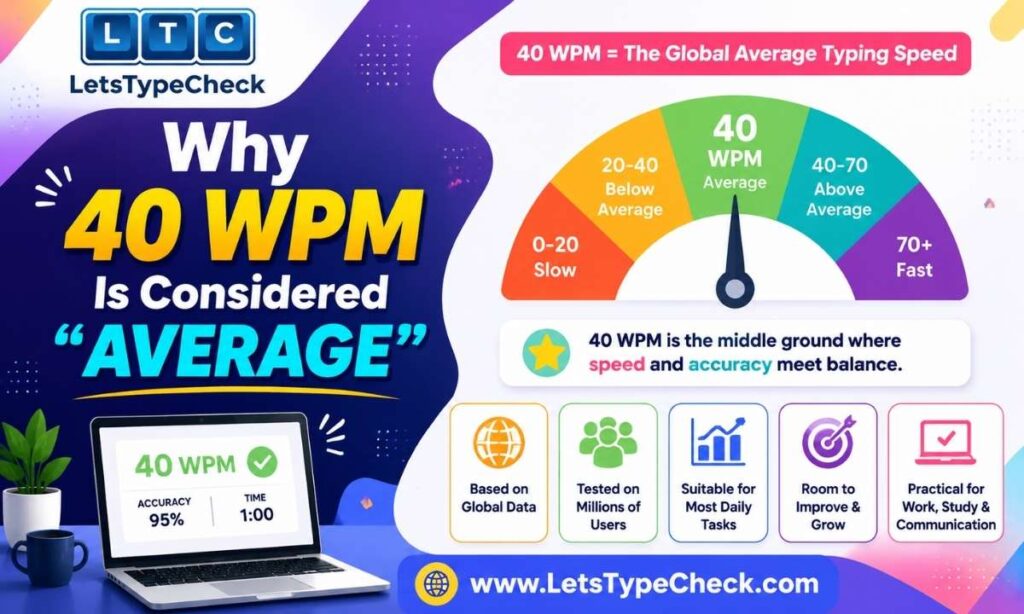
Forty WPM isn’t a marketing number — it’s roughly what shows up when you measure typing speed across everyday computer users who never took a formal typing course. Most people who picked up typing on their own, rather than through structured touch-typing lessons, settle somewhere in the 35–45 WPM range.
Typing speed is measured using a standardized “word” — every 5 characters, including spaces, counts as one word. That’s why WPM stays consistent no matter what you type. If you want the full formula and a worked example, see what WPM actually means.
For comparison, most people speak at somewhere between two and three times that pace in normal conversation — a reminder that typing and speaking rely on entirely different motor skills, so the gap between them isn’t something to worry about.
40 WPM by Context
For Everyday Use
If you’re typing emails, messages, notes, or browsing, 40 WPM is more than enough. A 100-word email takes under three minutes to type at this speed, which isn’t a meaningful bottleneck for most people’s daily routine.
For Office and Admin Jobs
Most general office roles list 40 WPM as a minimum, not a target. You’ll clear the bar, but candidates typing 55–60 WPM will typically look stronger on paper for administrative and customer-facing roles where typing volume is high. Roles like executive assistant or high-volume customer support tend to set the bar even higher, since typing is a core part of the job rather than an occasional task.
For Data Entry Jobs
Data entry is the clearest case where 40 WPM falls short. Most data entry employers look for 45–60 WPM as a baseline, with some roles asking for more. For a full breakdown of what different roles expect, see our typing test for jobs guide, which covers WPM requirements across data entry and other typing-heavy positions.
For Government Exams (India)
This is where 40 WPM performs best. Most Indian government typing exams set their minimums well below 40 WPM — so if you’re preparing for one of these, you likely already have room to spare:
- SSC CHSL / CGL: typically requires roughly 35 WPM English (varies by post)
- CPCT: requires 30 WPM English net speed to qualify
- RRB NTPC: requires around 30 WPM English for most posts
See our dedicated guides for SSC CHSL, CPCT, and RRB NTPC typing tests for exact requirements and practice plans.
For Students
Whether 40 WPM is good for a student depends heavily on age and grade. It’s a strong result for a middle schooler and an average one for a university student. Check our average typing speed by age guide to see where 40 WPM lands for your exact age group.
Does Accuracy Change the Answer?
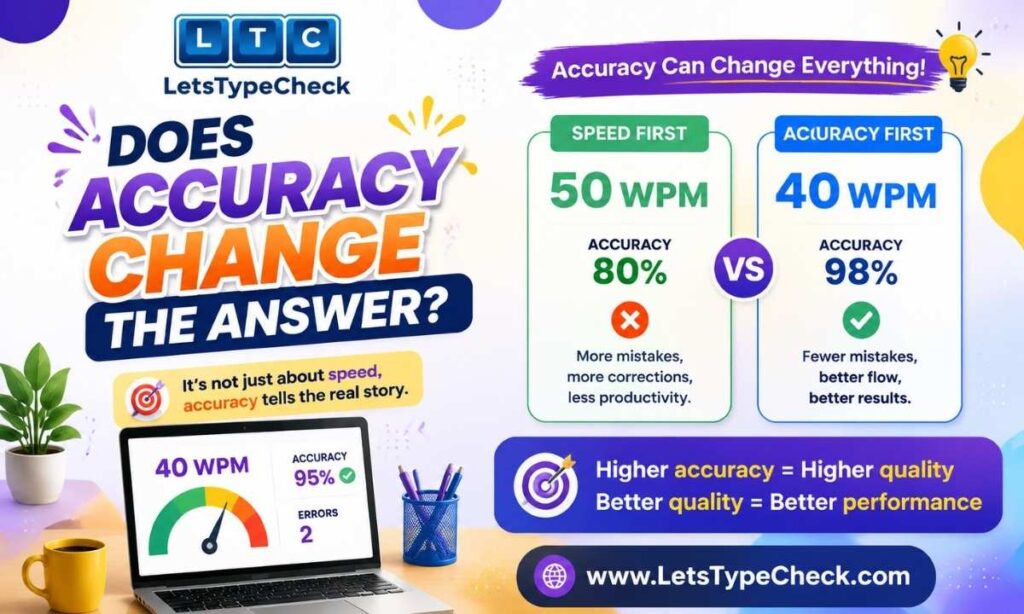
Yes — and often more than people expect. A high WPM with poor accuracy can actually be less productive than a slightly lower WPM typed cleanly, because every mistake costs time to notice and fix.
Consider two typists:
- Typist A: 42 WPM at 97% accuracy
- Typist B: 55 WPM at 84% accuracy
On paper, Typist B looks faster. But once errors are factored in, the effective, usable output narrows the gap considerably — and Typist A’s copy needs far less proofreading afterward. This is why most tests and employers report net WPM rather than gross WPM — it reflects real, usable typing speed rather than raw finger speed.
How 40 WPM Compares to Other Speed Tiers
Here’s how 40 WPM sits against the broader typing speed scale:
| Tier | WPM Range | Where 40 WPM Fits |
| Beginner | Under 25 WPM | 40 WPM is well above this tier |
| Average | 35–45 WPM | This is where 40 WPM sits |
| Above Average | 50–65 WPM | The next realistic goal |
| Proficient | 65–80 WPM | Reachable with sustained practice |
| Advanced / Expert | 80+ WPM | Requires dedicated, long-term training |
For a deeper look at every tier with job and age context, see our full guide to good typing speed.
Should You Improve Beyond 40 WPM?
If 40 WPM already covers what you need — email, messaging, casual computer use — there’s no requirement to push further. But if you’re aiming at data entry roles, transcription, or simply want to save time on daily typing tasks, moving from 40 to 60 WPM is a realistic goal within four to six weeks of consistent, focused practice.
- Practice daily in short sessions rather than occasional long ones
- Prioritize accuracy first — speed follows once mistakes drop
- Use touch typing instead of looking at the keyboard
Start with our step-by-step guide to reaching 60 WPM, or browse proven tips to type faster and daily typing practice exercises to build a routine.
Test Your Speed

The only way to know exactly where you stand is to take a real test under timed conditions. Our free typing test shows your WPM, accuracy, time left, and mistakes in one results panel — no sign-up, and no certificate to worry about, just an honest read on your current speed so you know exactly what to work on next.
Frequently Asked Questions
Is 40 WPM good for a job interview?
It meets the minimum for most general office roles, but it won’t stand out. For data-entry or admin positions, aim for 50 WPM or higher before you test.
Is 40 WPM fast or slow for a beginner?
It’s actually strong for a beginner — most people just starting out type 15–25 WPM. Forty WPM suggests you already have decent muscle memory.
Is 40 WPM good for a 12-year-old?
Yes, that’s above average for that age group. Most students that age fall in the 15–30 WPM range depending on how much typing practice they’ve had.
How long does it take to go from 40 to 60 WPM?
With consistent daily practice, most people reach 60 WPM in four to six weeks. Progress depends on how much you practice and how focused those sessions are.
Is 40 WPM good enough for government exams in India?
Yes, in most cases. Exams like CPCT and RRB NTPC require around 30 WPM, and SSC posts typically ask for about 35 WPM, so 40 WPM clears the bar with some margin.
Does accuracy matter more than speed at 40 WPM?
Often, yes. A clean 40 WPM with 98% accuracy is more useful in practice than a faster speed riddled with errors that need fixing afterward.
Conclusion
40 WPM is a perfectly normal place to be — fast enough for everyday typing and most government exams, but a step behind where data entry and transcription roles typically expect you. If your current speed is doing the job, there’s no need to chase a bigger number. If it isn’t, the path from 40 to 60 WPM is short and mostly comes down to consistent practice and clean accuracy, not raw talent.