
A 30-second typing test measures your burst typing speed — the fastest pace your fingers can sustain in a single short sprint, before fatigue, hesitation, or a long passage starts pulling your average down. It’s the shortest common typing test duration, and it’s built for one purpose: showing you your peak WPM, not your steady-state speed. Take the test above to see your burst score, then read on to understand what it means and how it compares to longer typing tests.
Unlike a 1-minute or 5-minute typing test, a 30-second burst test isn’t meant to represent how fast you type during a real work session or exam. It’s a snapshot of maximum output over a very short window, which makes it a popular warm-up drill, a confidence-builder for beginners, and a training tool for typists chasing a higher personal best. Below, we break down how burst speed differs from average WPM, what scores are considered good, and how to use short 30-second sprints to raise your overall typing speed.
What Is Burst Typing Speed?
Burst typing speed is the fastest pace you can reach over a short stretch, usually 30 seconds or less. In a test that short, you don’t have time to tire or lose focus, so the result shows your top speed rather than the speed you can hold.
That makes burst WPM different from sustained WPM, which is what a 1-minute or 2-minute typing test measures. Most typists score higher over 30 seconds than over two minutes. The size of that gap tells you something useful: a small gap means your speed is consistent, while a large gap usually means your rhythm or accuracy slips as the test goes on.
What Is a 30 Second Typing Test?
A 30-second typing test is a timed typing speed test that runs for half a minute. You type a given passage or word set as quickly and accurately as possible, and at the end you get your WPM (words per minute) and accuracy score, calculated and scaled up from those 30 seconds.
- Duration: 30 seconds, the shortest standard test length alongside 15-second tests
- Purpose: measures burst/peak typing speed rather than sustained speed
- Output: WPM (gross and net), accuracy percentage, and often a raw keystroke count
- Best for: quick checks, warm-ups, and repeatable sprint practice
What Is Burst Typing Speed? (Peak WPM vs Average Speed)
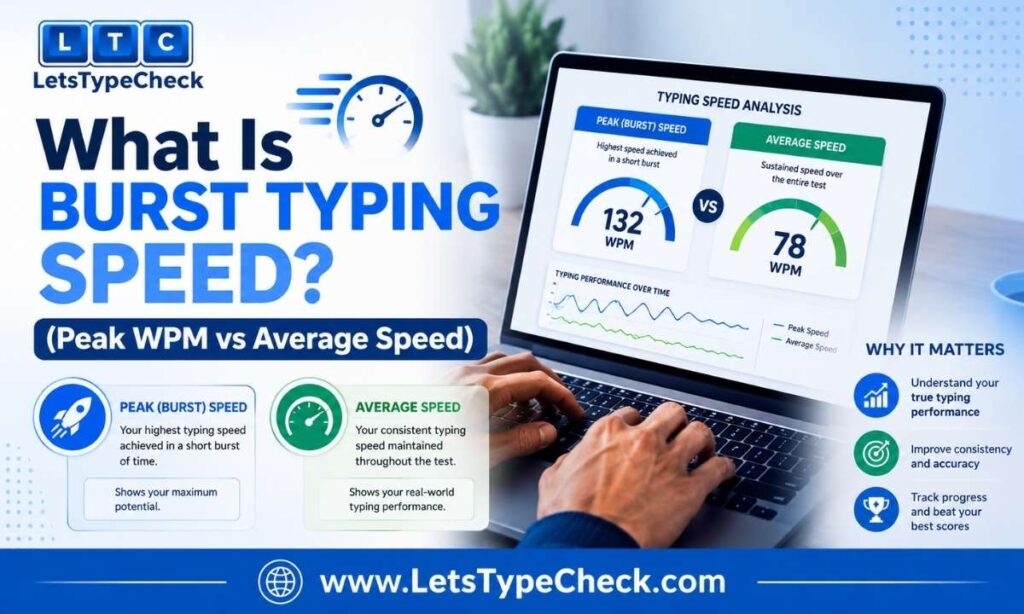
Burst typing speed is the maximum WPM you can hit over a very short stretch of typing — a few seconds to half a minute — before rhythm, accuracy, or stamina start to level it off. It’s the typing equivalent of a sprint versus a marathon: a 100-meter sprinter’s top speed is always faster than their per-kilometer marathon pace, and the same principle applies to typing. Your burst WPM on a 30-second test will almost always be higher than your WPM on a 1-minute, 2-minute, or 5-minute test of the same passage.
- Burst speed reflects your ceiling — the fastest your fingers can currently move.
- Average/sustained speed reflects your floor over a longer, more realistic stretch.
- The gap between the two shrinks as your typing becomes more consistent and automatic.
- Competitive and casual typists often track burst speed as a separate personal-best metric, distinct from their 1-minute or 5-minute average.
How Is WPM Calculated in a 30 Second Speed Test?
WPM is calculated the same way regardless of test length: total characters typed, divided by 5 (the standard length of an average word), divided by the time elapsed in minutes. In a 30-second test, that means your raw keystroke count is halved before being reported as a per-minute rate.
- Formula: (Total characters typed ÷ 5) ÷ (time in minutes) = WPM
- For a 30-second test: (characters ÷ 5) ÷ 0.5 = WPM
- Example: typing 125 correct characters in 30 seconds = 25 words ÷ 0.5 minutes = 50 WPM
Gross WPM vs Net WPM in Short Typing Tests
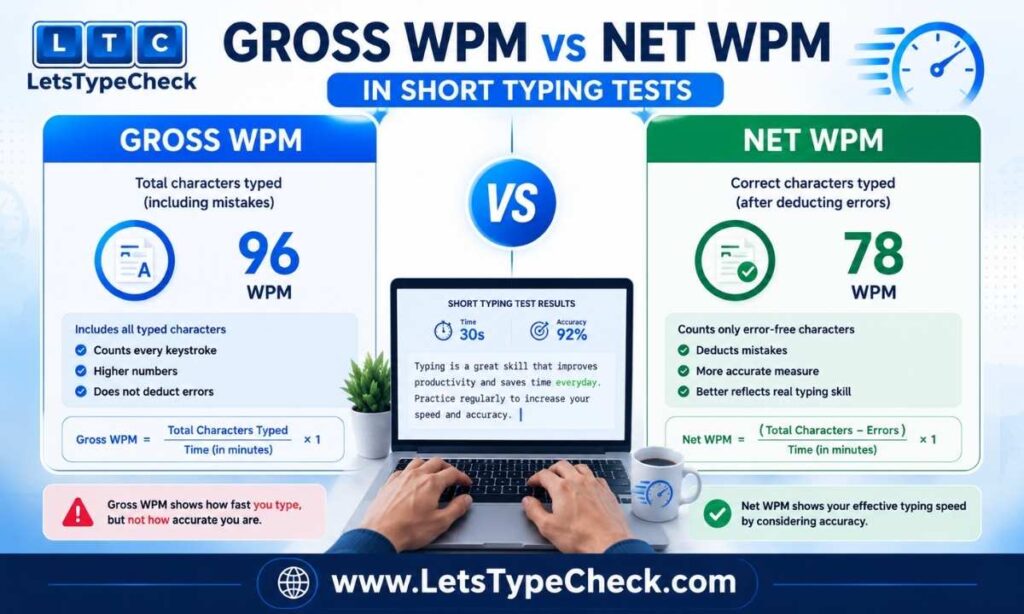
Gross WPM counts every character you typed, mistakes included. Net WPM subtracts a penalty for errors, giving a more accurate picture of your real, usable typing speed. In a 30-second test, a single typo has a bigger relative impact on your score than it would in a 5-minute test, since there’s less time to “average out” the mistake.
- Gross WPM = raw typing speed, ignoring errors.
- Net WPM = Gross WPM minus an error penalty (commonly errors per minute).
- Because the window is short, one or two mistakes can swing a 30-second score noticeably more than they would on a longer test.
What Is a Good 30 Second Typing Speed? (Burst WPM Benchmarks)
Because burst speed runs higher than sustained speed, a “good” 30-second score is generally a few WPM above what the same typist would score on a 1-minute or 5-minute test. Use these ranges as a rough guide rather than a strict benchmark, since burst scores vary more from attempt to attempt than longer, steadier tests.
- Below 20 WPM: Beginner — still building muscle memory and key familiarity,
- 20–40 WPM: Casual typist — comfortable with everyday typing, average burst range for most adults.
- 40–60 WPM: Intermediate — solid office-level typing speed, common among regular computer users.
- 60–80 WPM: Advanced — fast, confident typing; suitable for data entry and transcription-adjacent work.
- 80+ WPM: Expert — competitive-level burst speed, typically only reached with dedicated practice.
30 Second vs 1 Minute vs 2 Minute Typing Test — Which Should You Take?
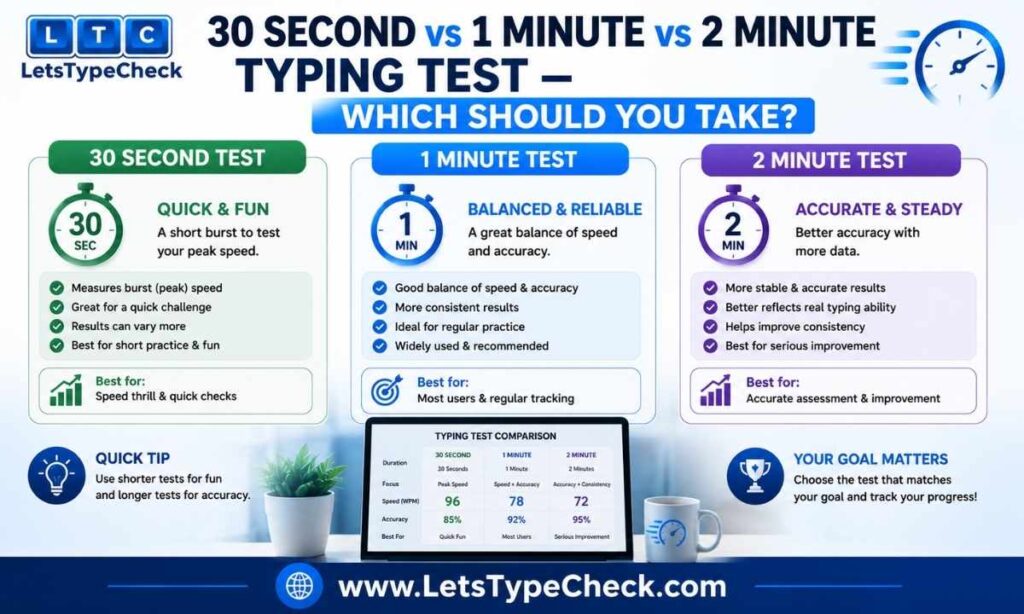
Each test duration measures something slightly different. A 30-second test shows your ceiling; longer tests show how well you hold that ceiling over time. Neither is “more correct” — they answer different questions.
- 30-second test: peak/burst speed, best for warm-ups and quick checks.
- 1 minute test: the most common general-purpose benchmark, balances speed and consistency.
- 2 minute test: shows whether your speed holds steady past the first burst.
- 5 minute test: the closest to real sustained typing, and the standard most employers and exams use.
If you want to compare your burst speed against your sustained speed, try the same passage on the 1 minute typing test or the 2 minute typing test and compare your WPM across durations.
Why Burst Speed Matters for Typing Practice and Warm-Ups
Burst speed isn’t just a vanity number — short sprints are a recognized training method for raising your overall typing speed over time, even though the score itself doesn’t reflect real-world sustained typing.
- Warm-up tool: a 30-second sprint before a longer practice session activates muscle memory without causing fatigue
- Confidence builder: seeing a higher burst number than your 1-minute average shows your ceiling is higher than your current habits allow
- Competitive benchmark: typists chasing personal bests often track burst WPM as a separate record from their standard test score
- Not a hiring or exam metric: most employers and government exams (SSC, CPCT, and similar) use 1-minute, 5-minute, or longer tests, not 30-second bursts, so don’t use a burst score to judge exam readiness
How to Improve Your Burst Typing Speed? (Sprint Method & Drills)
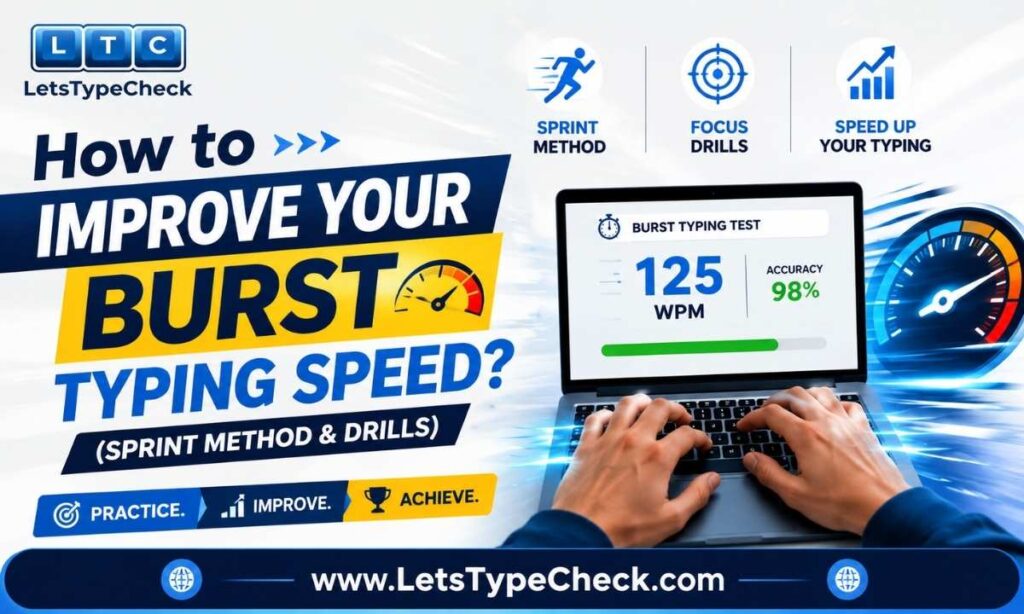
The most common technique for raising burst speed is interval-style sprint training, sometimes called the “sprint method”: short, maximum-effort typing bursts separated by rest, repeated several times in a session.
- Set a 30-second timer and type as fast as possible — don’t worry about errors during the sprint itself.
- Rest for 30 seconds between sprints to let your hands recover.
- Repeat 8–10 times in a session to train your fingers past their normal comfort speed.
- Review accuracy after the session, not during it — sprint training is for speed; accuracy work happens separately.
- Alternate sprint sessions with slower, accuracy-focused practice so speed gains don’t get baked in as bad habits.
How Your 30-Second Score Is Calculated
WPM treats every 5 characters as one word, including spaces. A 30-second test is half a minute, so the result is doubled to give a per-minute figure.
For example, if you type 200 characters in 30 seconds, that’s 40 words. Forty words in half a minute works out to 80 WPM.
Doubling the result also doubles the effect of any hesitation. A two-second pause costs you far more in a 30-second test than in a longer one. Mistakes count for more too, because each one is a bigger share of a short test. That’s why the results panel shows Accuracy and Mistakes separately from WPM. A fast burst score with low accuracy isn’t a speed you can rely on yet.
Tips for an Accurate 30 Second WPM Score
Because the test window is so short, small setup mistakes have an outsized effect on your result. A few adjustments make your 30-second score more representative of your real burst speed.
- Don’t rest your hands right before starting — begin from a natural, already-warm position.
- Keep wrists floating above the desk rather than resting on it, to avoid tension slowing your fingers.
- Start at a controlled pace for the first few seconds, then push toward your top speed — a panicked start creates errors that cost more than they would in a longer test.
- Run the test 2–3 times and take your best or average score, since 30-second results vary more than longer tests.
- Keep your eyes on the screen, not the keyboard, to avoid losing time on every glance down.
How to Improve Your Burst WPM
Warm up first. Your first attempt is rarely your best. Take one or two easy runs before the attempt you want to count.
Stay on the home row. In 30 seconds there’s no time to recover from looking down at the keyboard. Every glance shows up directly in your score.
Type through small errors. Stopping to fix every mistake breaks your rhythm. On short tests, keep moving, and bring your error rate down separately with accuracy drills.
Use short tests as sprints, not your benchmark. Burst tests are good for pushing your top speed, but the speed you can hold over a minute or two is the one that matters for jobs and exams. Compare your 30-second score with a longer test each week to check the gap is shrinking.
Frequently Asked Questions
What is burst WPM?
Burst WPM is your typing speed over a very short test, usually 30 seconds or less. It shows your top speed before fatigue or loss of focus sets in.
Is my 30-second score my real typing speed?
It’s your peak speed, not your everyday speed. For a figure you can put on a resume or rely on for an exam, use a 1- or 2-minute test. That score is usually lower but more realistic.
What is a good burst typing speed?
Judge it against the same ranges as any typing test, then expect your longer-test score to be somewhat lower. The typing speed benchmarks guide breaks those ranges down by level.
Is 30 seconds enough to measure typing speed accurately?
It’s enough to measure your burst/peak speed, but not your sustained speed. For a more complete picture, pair a 30-second test with a longer 1-minute or 5-minute test.
Why is my burst speed higher than my 1-minute speed?
Short tests capture your top speed before fatigue, hesitation, or accumulated errors bring your pace down. Over a longer test, your speed naturally settles toward a lower, more sustainable average.
What is the average WPM for a 30-second typing test?
Most casual typists score in the 20–40 WPM range on a burst test, similar to or slightly above their average 1-minute WPM. Regular typists often land between 40–60 WPM.
Can I use a 30-second test to prepare for exams like SSC or CPCT?
Not directly — government and employment typing exams almost always use longer durations (1 to 15 minutes). Use the 30-second test as a warm-up before practicing on exam-length tests.
How often should I practice burst speed drills?
A few sprint sessions per week, using 8–10 short bursts each time, is enough to see gains. Pair sprint sessions with slower, accuracy-focused practice on other days.
Does accuracy matter on a 30-second burst test?
Yes — accuracy still affects your net WPM, and errors have a proportionally bigger impact in a short test. For pure sprint training, though, many typists intentionally ignore errors during the burst and review accuracy afterward.