
If you want to get faster and more accurate at typing, single words and short sentences only take you so far. Real improvement comes from typing full paragraphs — the kind of continuous, flowing text you’ll actually face in a typing test, at work, or in an exam. Below you’ll find free typing paragraphs organized by difficulty (Easy, Medium, Hard) and by test duration, so you can pick text that matches exactly where you are and what you’re practicing for.
Every paragraph here is original and comes with a word count, so you can time yourself accurately. Once you’ve picked one, take it straight into our free typing test and see your Time Left, WPM, Accuracy, and Mistakes in real time.
Why Practice With Paragraphs Instead of Words or Sentences
Typing individual words or short sentences trains your fingers on isolated bursts, but it doesn’t build the steady rhythm that real typing requires. A paragraph forces you to keep moving through commas, capital letters, and sentence breaks without losing your pace — which is exactly what determines your real-world words-per-minute.
Paragraph practice also gives you a far more reliable speed reading. A 10-second word drill can make you look faster than you actually are, because a lucky run of short, easy words inflates the number. A full paragraph averages out the easy and hard sections, so the WPM you get is closer to what you’d type in a real test or on the job. If you’re not sure how your result compares, see average typing speed by age for context.
How These Paragraphs Are Organized by Difficulty
The Easy, Medium, and Hard labels below follow the same logic our typing test uses for its difficulty levels. Difficulty is driven purely by vocabulary and sentence complexity — not by punctuation, numbers, or capitalization. In other words:
- Easy: everyday words, short and simple sentence structures.
- Medium: broader vocabulary, longer sentences with more clauses.
- Hard: technical or formal vocabulary and denser, more complex sentence construction.
For a deeper breakdown of how each level is built and when to move up, read our full difficulty levels guide.
Easy Typing Paragraphs (Beginner)
These use common words and short, simple sentences. Ideal if you’re new to typing, still learning finger placement, or warming up before a harder session.
A Walk in the Park (58 words)
Every morning I like to take a short walk in the park near my home. The air feels fresh and the birds sing softly in the trees. I often see other people walking their dogs or jogging along the path. A simple walk can clear your mind and give you energy for the rest of the day.
My Favorite Meal (51 words)
My favorite meal is a warm bowl of soup with fresh bread on the side. I like to cook it on cold evenings when I want something comforting. Adding a few herbs makes the soup taste even better. Sharing a meal like this with family always feels special.
Learning to Swim (51 words)
Last summer I decided to learn how to swim. At first I was a little scared of the water, but my teacher was very patient with me. Each week I practiced a little more and slowly gained confidence. Now I can swim across the pool without stopping.
A Rainy Day (50 words)
It started raining early in the morning and did not stop all day. I stayed inside and read a book by the window. The sound of rain falling on the roof was calm and steady. Some days like this are perfect for slowing down and resting.
Growing a Garden (44 words)
My grandmother has a small garden behind her house. She grows tomatoes, flowers, and a few herbs every year. I love helping her water the plants on weekends. Watching something grow from a tiny seed always feels like a small miracle.
A New Puppy (51 words)
We brought home a new puppy last week and the whole family is excited. He is small and full of energy, running around the living room all day. He still needs to learn a few basic commands. Training him will take time, but it will be worth it.
Medium Typing Paragraphs (Intermediate)
These use broader vocabulary and longer sentences with more clauses. A good fit once you’re comfortable with easy text and ready to build real speed.
The Value of a Daily Routine (76 words)
Establishing a daily routine can make a noticeable difference in how productive and organized a person feels. When tasks are scheduled at consistent times, the mind spends less energy deciding what to do next and more energy actually doing it. A predictable structure also reduces stress, since unexpected demands are easier to handle when the rest of the day is already accounted for. Over time, small consistent habits tend to produce far greater results than occasional bursts of effort.
Understanding Renewable Energy (72 words)
Renewable energy sources, such as solar and wind power, are becoming increasingly important as countries look for ways to reduce their dependence on fossil fuels. Unlike coal or oil, these sources do not run out and generally produce far less pollution during operation. However, building the infrastructure required to capture and store this energy efficiently remains a significant technical and financial challenge. Continued investment in research is expected to gradually lower costs and improve reliability.
The Role of Feedback at Work (68 words)
Constructive feedback plays an essential role in professional growth, yet many workplaces struggle to deliver it effectively. Feedback that focuses on specific behaviors, rather than general impressions, tends to be far more useful to the person receiving it. It also helps when feedback is given regularly instead of being saved for an annual review, since small course corrections are easier to make than sweeping changes after months of drift.
Adjusting to a New City (70 words)
Moving to a new city often brings a mix of excitement and uncertainty. Simple tasks that once felt automatic, like finding a grocery store or navigating public transport, suddenly require conscious effort and a bit of trial and error. Most people find that this discomfort fades within a few months as familiar routines begin to form again. Building a small circle of local connections tends to speed up that sense of belonging considerably.
The Science of Good Sleep (74 words)
Quality sleep affects nearly every aspect of daily functioning, from concentration and memory to mood and physical health. Research consistently shows that maintaining a consistent sleep schedule, even on weekends, helps regulate the body’s internal clock more effectively than simply aiming for a certain number of hours each night. Reducing screen exposure before bed and keeping the room cool and dark are two of the most reliable ways to improve sleep quality without medication.
The Shift Toward Remote Work (68 words)
Over the past several years, remote work has shifted from an occasional perk to a standard expectation for many professionals. Companies have had to rethink how they measure productivity, moving away from simple attendance and toward tangible output and results. While remote arrangements offer clear benefits in flexibility, they also introduce new challenges around collaboration and maintaining a sense of team culture across different locations and time zones.
Hard Typing Paragraphs (Advanced)
These use technical or formal vocabulary and denser sentence construction — closer to what you’d encounter in professional writing, reports, or advanced exam passages.
Cognitive Load in Complex Decision-Making (78 words)
Cognitive load theory suggests that working memory has a finite capacity, which means that tasks requiring simultaneous evaluation of multiple interdependent variables can quickly overwhelm an individual’s ability to reason effectively. In high-stakes professional environments — financial forecasting, medical diagnostics, or crisis management, for instance — decision-makers often rely on heuristics not because they are lazy, but because heuristics offload some of that cognitive burden, trading a degree of precision for tractability under time constraints.
Macroeconomic Implications of Monetary Tightening (74 words)
When a central bank raises interest rates in an effort to curb inflation, the resulting increase in borrowing costs tends to ripple through the broader economy in ways that are neither immediate nor uniform across sectors. Capital-intensive industries, which depend heavily on financing for expansion, typically experience contraction sooner than consumer staples; meanwhile, the labor market often lags several quarters behind, since employers are generally reluctant to reduce headcount until existing order backlogs are exhausted.
The Architecture of Distributed Systems (73 words)
Designing a fault-tolerant distributed system requires reconciling consistency, availability, and partition tolerance — a trade-off formalized by the CAP theorem — while accounting for the reality that network partitions are not hypothetical edge cases but recurring operational conditions. Engineers must therefore decide, often at the architectural level rather than the implementation level, whether a given subsystem should prioritize strict consistency at the cost of temporary unavailability, or favor availability while tolerating eventual, rather than immediate, consistency.
Jurisdictional Complexity in Cross-Border Litigation (70 words)
Cross-border commercial disputes frequently hinge not on the substantive merits of a claim but on preliminary jurisdictional questions, including which forum’s procedural rules apply and whether a prior arbitration clause supersedes the right to pursue litigation in a national court. Conflicting statutory frameworks between jurisdictions can produce outcomes that appear inconsistent to a layperson, even though each ruling may be entirely defensible under the specific legal tradition from which it originates.
Epidemiological Modeling Under Uncertainty (71 words)
Constructing an epidemiological model that accurately forecasts disease transmission requires balancing biological plausibility against the practical limitations of available surveillance data, which is frequently incomplete, delayed, or subject to reporting bias across different regions. Modelers must therefore make explicit assumptions about underreporting rates and contact patterns, and communicate the resulting uncertainty transparently, since a single point estimate can be dangerously misleading when the true range of plausible outcomes is considerably wider.
The Ethics of Algorithmic Hiring (76 words)
As organizations increasingly delegate initial candidate screening to automated systems, questions of algorithmic fairness have moved from an academic concern to a matter of substantial legal and reputational exposure. A model trained on historical hiring data may inadvertently encode past discriminatory patterns, even when explicitly prohibited attributes are excluded from the input features, because proxy variables — such as postal code or graduation year — can correlate strongly enough with protected characteristics to reproduce the same biased outcomes indirectly.
Which Difficulty Should You Start With?
If you’re not sure where to begin, use your current typing speed as a guide. For context on what counts as beginner, average, or advanced at your age or for your target job, check what is a good typing speed.
| Your current speed | Recommended starting difficulty |
| Below 25 WPM, or still learning finger placement | Easy |
| 25–45 WPM with reasonably steady accuracy | Medium |
| 45+ WPM with 95%+ accuracy on Medium text | Hard |
A simple rule of thumb: move up a level once you can comfortably hit 95% accuracy or higher at your current difficulty. Chasing speed before accuracy usually just means you’re building fast, sloppy habits instead of real skill.
Typing Paragraphs by Test Duration: 30 Seconds, 1 Minute, 2 Minutes
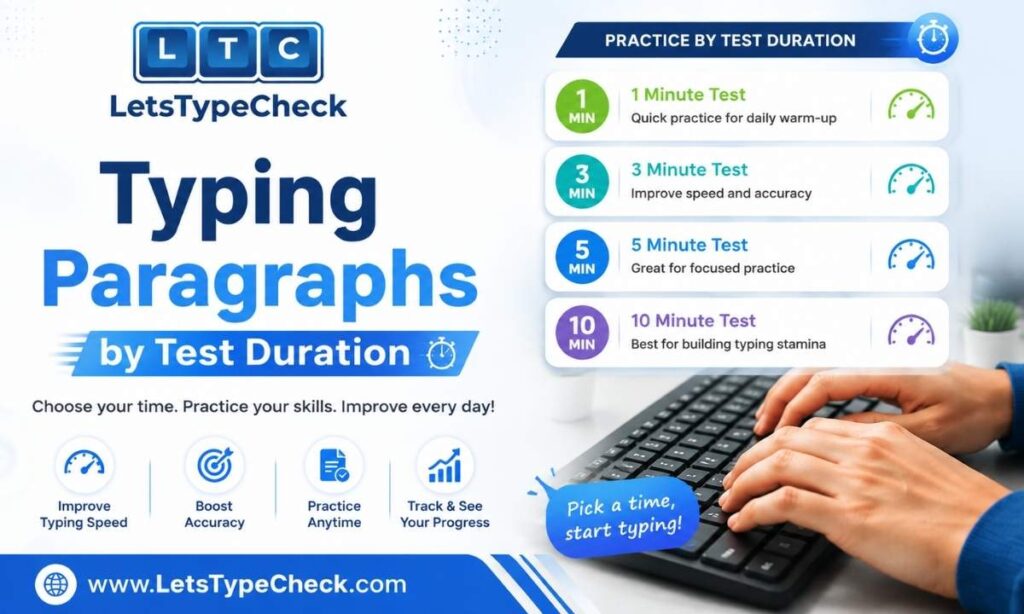
Our typing test supports durations up to 2 minutes by design — long enough to give a reliable speed reading without turning practice into an endurance exercise. Here’s roughly how much text you’ll need to fill each duration at an average pace, along with a short paragraph sized for each:
| Duration | ~Words at 40 WPM | ~Words at 60 WPM |
| 30 seconds | ~20 words | ~30 words |
| 1 minute | ~40 words | ~60 words |
| 2 minutes | ~80 words | ~120 words |
30-Second Practice Paragraph (24 words)
The quick brown fox jumps over the lazy dog near the old wooden fence while the warm afternoon sun slowly fades behind the distant hills.
Try this on our 30 second typing test for a fast burst-speed check.
1-Minute Practice Paragraph (48 words)
Learning a new skill rarely happens overnight. It usually takes small, consistent steps repeated over time before real progress becomes visible. Typing is no different — a few focused minutes of daily practice will do far more for your speed and accuracy than one long, exhausting session every few weeks.
Take this straight to our 1 minute typing test to check your score.
2-Minute Practice Paragraph (96 words)
Effective communication depends on more than just choosing the right words — it also requires paying close attention to how a message is received. A well-written email, for example, should be clear enough that the reader understands exactly what is being asked of them without needing to reread it several times. This is especially important in professional settings, where ambiguity can lead to wasted time, missed deadlines, or simple misunderstandings. Taking a moment to reread your own message before sending it, from the recipient’s point of view, is a small habit that consistently pays off.
Use our 2 minute typing test to time yourself on a full passage like this one.
Practicing for Government Exams? (SSC, CPCT, RRB)
If you’re specifically preparing for an Indian government typing exam, the general paragraphs above are still useful for building baseline speed and accuracy, but each exam has its own scoring rules, qualifying WPM, and passage style. We’ve covered those in detail separately:
- SSC CHSL Typing Test — LDC/JSA vs DEO requirements
- CPCT Typing Test — 30 NWPM in 15 minutes explained
- RRB NTPC Typing Skill Test — full exam-day walkthrough
How to Use These Paragraphs With LetsTypeCheck’s Typing Test?
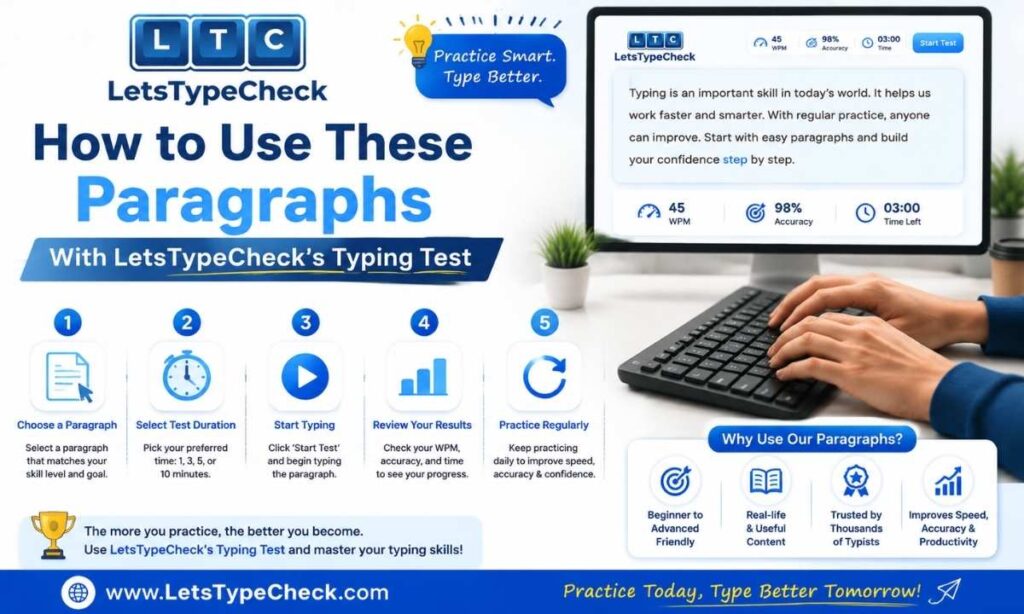
- Pick a paragraph that matches your current difficulty level, or one sized for the duration you want to practice.
- Open the typing test and select the matching duration and difficulty.
- Copy the paragraph into a notes app if you’d like a reference, or simply retype it from memory as you read it here.
- Type at a steady, comfortable pace — don’t rush the first attempt.
- Check your results: Time Left, WPM, Accuracy, and Mistakes are all shown separately, so you can see exactly where to improve.
- Repeat the same paragraph two or three times. Your speed will naturally increase once the words are familiar, which is a normal and useful part of practice.
One honest note: LetsTypeCheck does not currently offer a downloadable certificate — see our typing test certificate guide if a certificate is part of what you need.
Tips for Getting the Most Out of Paragraph Practice
Focus on accuracy before speed. A fast typist with poor accuracy loses more time to corrections than a slightly slower typist who rarely makes mistakes. For a full breakdown of technique, see how to type faster.
Keep your fingers anchored to the home row between keystrokes rather than reaching randomly across the keyboard. If you’re still building this habit, our finger placement guide walks through proper hand position step by step.
If you’re completely new to typing tests in general, start with our typing test for beginners guide before jumping into Hard-difficulty paragraphs.
Practice a little every day rather than a lot occasionally. Ten focused minutes daily builds muscle memory far more reliably than one long session once a week.
Frequently Asked Questions
Where can I find free typing paragraphs for practice?
Right here — every paragraph above is free to use, organized by difficulty (Easy, Medium, Hard) and by test duration. No sign-up is required to use them with our typing test.
What’s the difference between Easy, Medium, and Hard paragraphs?
See the breakdown near the top of this page — it’s driven by vocabulary and sentence complexity, not punctuation or numbers.
How long should a typing paragraph be for a 1-minute test?
Around 40 to 60 words, depending on your typing speed — roughly 40 words at 40 WPM, up to 60 words at 60 WPM. The 1-minute paragraph above (48 words) is sized for an average pace.
Are these paragraphs good for government exam practice?
They’ll build solid baseline speed and accuracy, but each exam scores differently — see the RRB NTPC guide, or the exam-specific links above, for exact qualifying speeds.
Do I need to sign up to practice?
No. You can copy any paragraph above and use it with our free typing test immediately, with no account or sign-up required.
Is there a certificate after completing a paragraph?
Not currently — LetsTypeCheck focuses on real-time performance data rather than downloadable certificates. If a certificate is a requirement for your exam or job application, our certificate guide explains what employers and exam boards typically expect.