
A 2 minute typing test is the most reliable quick way to measure your true typing speed and accuracy. While a 60-second sprint captures your burst pace, 120 seconds is long enough to smooth out lucky streaks and early nerves, yet short enough to fit into any practice session. That balance is exactly why the two-minute format has become the standard duration used by employers for screening, by typing platforms as their default benchmark, and by candidates preparing for government and data-entry exams. Take the free 2 minute typing test on LetsTypeCheck — select the 120s timer, choose Easy, Medium, or Hard, and get your WPM, accuracy, and mistake count instantly with no signup.
In this guide, you will learn exactly what a 2 minute typing test measures, how your WPM is calculated over 120 seconds, how many words you should realistically type in two minutes, and what score counts as good for jobs and competitive exams. You will also find proven techniques to raise your two-minute score, drawn from the same fundamentals covered in our guide on how to type faster.
What Is a 2 Minute Typing Test?
A 2 minute typing test is a timed assessment in which you type a displayed passage for exactly 120 seconds while the tool tracks every keystroke in real time. When the timer ends, you receive three core results:
- WPM (Words Per Minute): your typing speed, standardized so that every 5 characters — including spaces and punctuation — count as one word.
- Accuracy: the percentage of characters you typed correctly out of everything you pressed. High speed with low accuracy produces a weak net score.
- Mistakes: a live error count that shows exactly where you slipped, so you know which keys and words to practice.
On the LetsTypeCheck typing test, the timer starts automatically the moment you begin typing, errors are highlighted as they happen, and your best scores are saved to a local leaderboard so you can track progress across attempts.
2 Minutes vs Other Test Durations: Why 120 Seconds Is the Sweet Spot
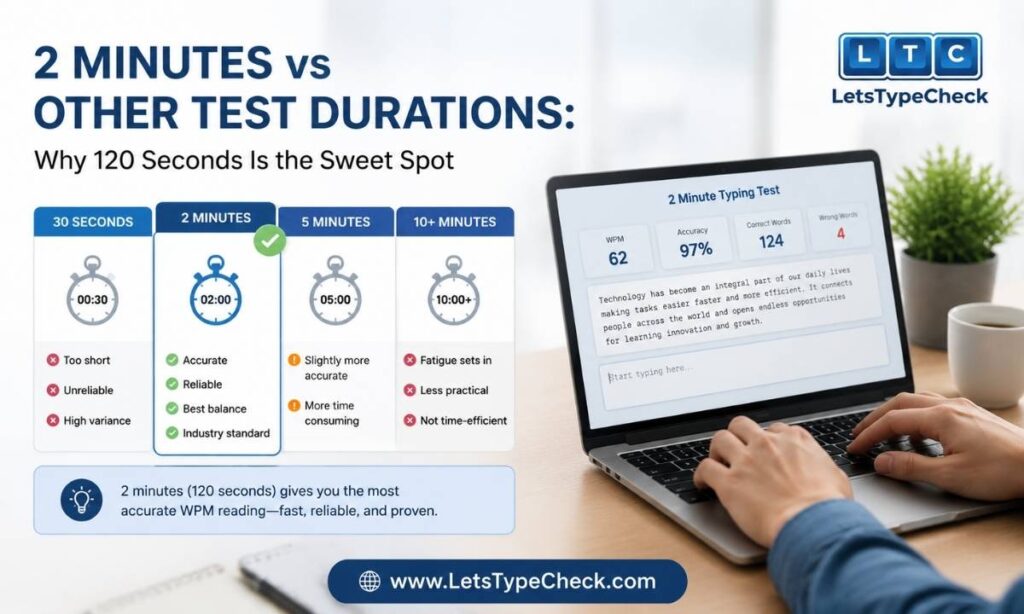
Every test length answers a different question about your typing. Here is how the two-minute format compares:
- 1 minute — burst speed. A 60-second test measures your peak pace, which typically runs 10–20 WPM higher than the speed you can actually sustain. It is ideal for warm-ups and quick checks.
- 2 minutes — the standard. Long enough that fatigue, rhythm, and consistency start to show, short enough to repeat several times per session. This is the duration most platforms treat as their default and many employers use for screening.
- 5 minutes — sustained speed. Measures the pace you can hold through a full passage. Most government exams and certificate tests use 5–10 minute formats.
- 10–30 minutes — endurance. Extended tests build the mental and physical stamina needed for real work sessions and long exam papers.
A smart routine uses all of them: warm up with 1 minute, benchmark with 2 minutes, and build stamina with longer runs. Your 2 minute score is the number that best predicts everyday performance.
How WPM Is Calculated in a 2 Minute Typing Test?
The formula is the same industry standard used across typing platforms and employment tests:
- WPM = (Total correct characters ÷ 5) ÷ minutes elapsed. Every 5 characters — letters, spaces, and punctuation — count as one standardized word.
- Worked example: typing 500 correct characters in 2 minutes equals (500 ÷ 5) ÷ 2 = 50 WPM.
- Gross vs Net WPM: gross WPM counts everything you typed; net WPM subtracts errors. Employers and exams score net WPM, which is why accuracy matters just as much as raw speed.
- CPM alternative: some tests report Characters Per Minute instead, which is roughly 5 times your WPM. A 250 CPM score equals about 50 WPM.
How Many Words Should You Type in 2 Minutes?
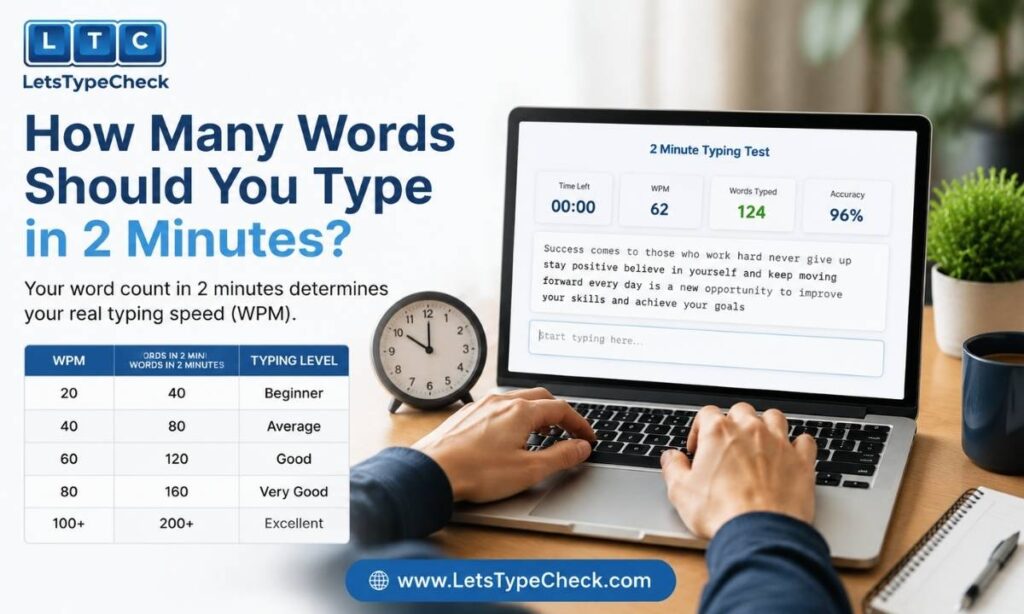
Because a 2 minute test doubles the time window, your raw word count is easy to convert to WPM — just divide by two. Use this table to see instantly where your two-minute word count places you:
| Words Typed in 2 Minutes | WPM | Skill Level |
| 40–50 words | 20–25 WPM | Beginner |
| 70–80 words | 35–40 WPM | Average typist |
| 100–120 words | 50–60 WPM | Job-ready / intermediate |
| 130–160 words | 65–80 WPM | Professional |
| 170–200+ words | 85–100+ WPM | Expert / top 5% |
For a full breakdown of benchmarks by profession, age group, and exam requirements, see our complete guide to what is a good typing speed.
What Is a Good 2 Minute Typing Test Score?
- 40 WPM is the global average — sufficient for everyday email, browsing, and casual computer use.
- 50–60 WPM with 95%+ accuracy is the job-ready zone. Most data entry, administrative, and customer service roles screen candidates in this range.
- 60–80 WPM is professional level, expected in transcription, journalism, programming, and secretarial work.
- 80–100+ WPM puts you in the top 5% of typists worldwide; 100+ is elite territory occupied by competitive typists and court reporters.
- Exam thresholds: Indian government exams such as SSC, Banking, and Railways typically require 30–40 WPM with 95%+ accuracy, though scoring 50+ WPM gives you a clear edge over other candidates.
Why Employers and Exams Prefer the 2 Minute Format?
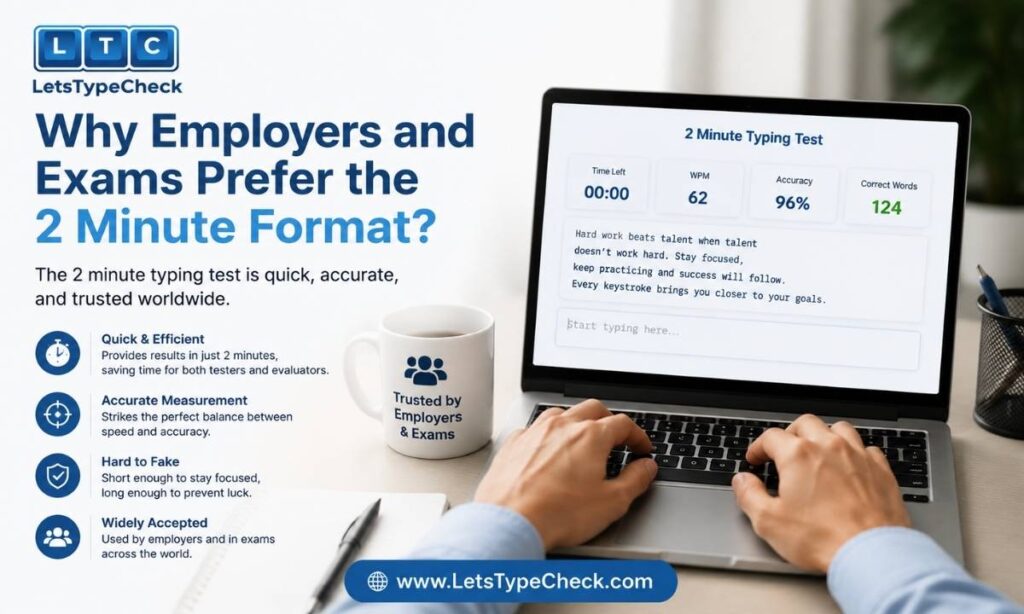
- It filters out burst-only typists: a candidate who peaks for 60 seconds but fades cannot hide over 120 seconds.
- It is fast to administer: recruiters can screen dozens of applicants without the time cost of 5–10 minute tests.
- It rewards consistency: a steady rhythm across two minutes correlates strongly with real workplace output, where typing happens in sustained stretches, not sprints.
- It penalizes uncorrected errors: net-WPM scoring over two minutes gives a truer picture of usable speed than a short accuracy-forgiving sprint.
How to Improve Your 2 Minute Typing Test Score?
Improving a two-minute score is about consistency, not just raw pace. Focus on these proven habits:
- Accuracy first, speed second: hold 95%+ accuracy before pushing pace. Every uncorrected error drags your net WPM down, and every backspace costs more time than typing slowly and correctly.
- Practice daily in short sessions: 15–20 minutes of focused daily practice builds muscle memory faster than occasional marathon sessions. Most people see a 10–20 WPM gain within a month.
- Learn touch typing: hunt-and-peck typing caps out around 25–35 WPM. Touch typing with all 10 fingers anchored on the home row (ASDF JKL;) removes that ceiling and lets your eyes stay on the screen.
- Keep a steady rhythm: burst-and-stop typing feels fast but measures slow. An even, metronome-like pace across the full 120 seconds produces a higher score than sprinting and stalling.
- Stop looking at the keyboard: each glance down costs up to a second. Over a 2 minute test, thirty glances can wipe 10–15 points off your WPM.
- Fix your posture: elbows at 90 degrees, wrists straight and slightly raised, screen at eye level. Poor positioning can cut accuracy by up to 20% and leads to strain over longer sessions.
- Drill the common words: words like “the,” “and,” “for,” and “with” appear constantly. Hesitating on them is a hidden speed leak — practice them until they are automatic.
Run the 120s mode on the LetsTypeCheck typing test once or twice a day, alternate difficulty levels, and watch your leaderboard scores climb week over week. For the complete training routine, read our 10 proven tips on how to type faster.
Frequently Asked Questions
What is a good score on a 2 minute typing test?
Around 40 WPM is average, 50–60 WPM is job-ready, and 80+ WPM is professional. Aim for 95%+ accuracy alongside your speed, because employers and exams score net WPM.
How is WPM calculated in a 2 minute typing test?
WPM = (correct characters ÷ 5) ÷ 2 minutes, with every 5 characters counting as one word. Typing 500 correct characters in two minutes equals 50 WPM.
Is a 2 minute test more accurate than a 1 minute test?
Yes — a 1 minute test captures burst speed that runs 10–20 WPM above your sustainable pace. Two minutes reveals your consistency, which better predicts real-world typing performance.
Is the LetsTypeCheck 2 minute typing test free?
Yes, completely free with no registration, downloads, or limits. Select the 120s timer on the test page, pick a difficulty, and your results appear instantly.
How long does it take to improve my 2 minute score?
With 15–20 minutes of daily practice, most typists see measurable improvement within 2–4 weeks and gain 10–20 WPM in a month. Reaching fluent touch typing typically takes 2–3 months.
Can I use a 2 minute typing test to prepare for government exams?
Absolutely — it is an ideal daily benchmark for SSC, Banking, and Railways preparation, which typically require 30–40 WPM at 95%+ accuracy. Combine it with longer 5–10 minute practice runs to match real exam durations.
What is the fastest typing speed ever recorded?
Stella Pajunas set the classic record of 216 WPM on an IBM electric typewriter in 1946, and Barbara Blackburn sustained 150+ WPM using a Dvorak layout. Modern competitive typists exceed 200 WPM in short bursts.