
Most people find out their typing speed from a test that lasts sixty seconds. That number feels good in the moment, but it’s measuring something closer to a sprint than a working pace. A five minute typing test tells a different story: it’s long enough for the adrenaline of the first line to wear off, long enough for a small mistake to actually cost you time instead of just resetting instantly, and long enough to show whether your speed holds up once your hands get tired.
That’s exactly why this is the format most employers, exam boards, and certification programs default to. If a job listing says you need to “type 45 WPM,” it almost never means for one frantic minute — it means you can hold that pace for a real stretch of typing. Run the test above, then use this page to understand what your number actually means and how to move it up.
What Makes a 5-Minute Test Different From a 1-Minute or 10-Minute Test
Every duration is measuring the same underlying skill, but each one isolates a different part of it. Think of it less as “which test is correct” and more as “which test matches what you’re trying to find out.”
When a 1-minute test is the better choice
A one-minute test is best used as a warm-up or a quick diagnostic — something you run two or three times in a row to see your peak number on a good attempt. It’s fast, it’s low-commitment, and it’s forgiving of a rough start. What it won’t tell you is whether you can hold that speed once the novelty wears off.
When you need something longer than 5 minutes
A ten-minute (or longer) session is built for endurance — it’s the format serious data-entry and transcription roles actually use to test candidates, because it exposes the fade that happens after several minutes of continuous typing. If your 5-minute score is solid but you suspect your speed drops off toward the end of a long shift, a longer session is the next test worth running.
You can switch between durations directly on our typing test tool and compare how your WPM shifts as the timer gets longer.
How WPM and Accuracy Are Calculated Over 5 Minutes
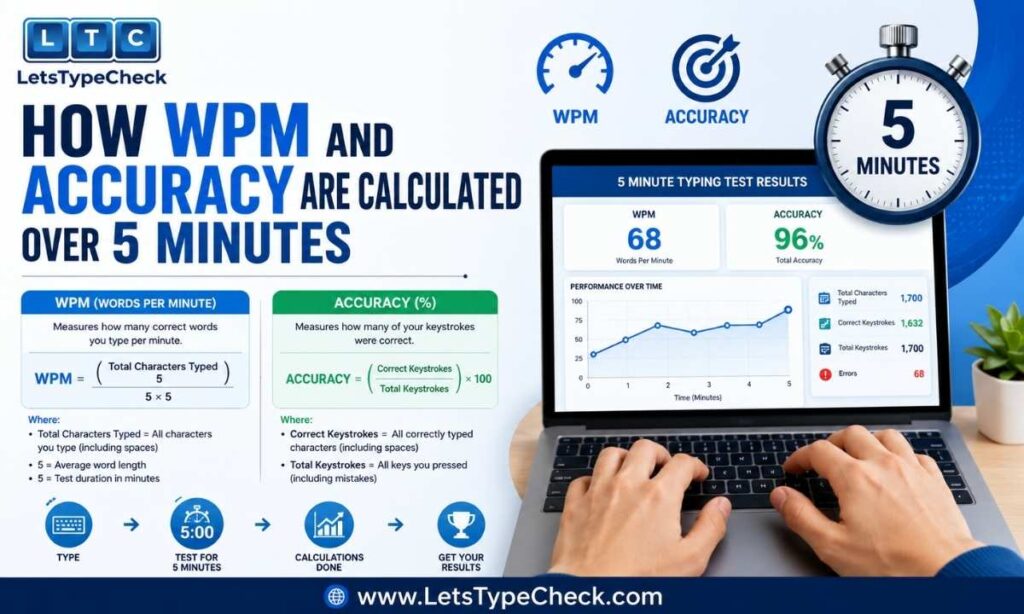
The formula itself doesn’t change with duration: your typing speed is calculated by dividing the number of correctly typed characters by five (the accepted average word length), then dividing that by the number of minutes you typed. Accuracy is simply the percentage of characters you typed correctly out of everything you attempted.
What does change is how reliable that number is. A single typo in a 1-minute test can swing your WPM by several points, because there’s so little typing to average it out against. Over 5 minutes, the same mistake barely moves the needle — you’ve typed roughly five times as many words, so one slip gets diluted into a much larger sample. That’s the real reason a 5-minute score is worth more than a 1-minute one when you need a number you can trust.
What’s a Good 5-Minute Typing Test Score?
“Good” depends entirely on what you’re comparing yourself to. Here’s a rough breakdown by experience level, specifically for a sustained 5-minute session rather than a short burst:
- Beginner (0–6 months of regular typing): 20–30 WPM
- Average / everyday computer user: 35–45 WPM
- Strong office typist: 50–65 WPM
- Professional (data entry, transcription, admin): 65–85 WPM
- Expert / court reporter tier: 90+ WPM
These ranges hold up across most durations, not just five minutes. For the full breakdown by job, age group, and exam board — plus how those numbers were put together — see What Is a Good Typing Speed?.
5-Minute Typing Tests for Exams and Job Applications
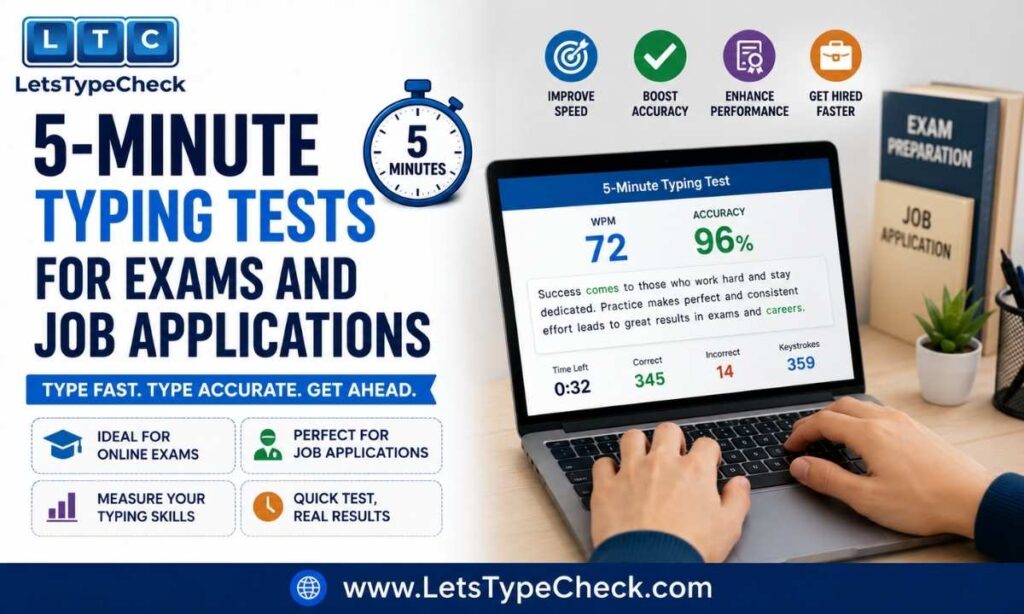
If you’re preparing for a specific exam or assessment, the 5-minute number is usually the one that matters — but what actually happens on test day varies more than people expect.
Government and competitive exams
Exams like SSC CHSL, SSC CGL, and RRB NTPC typically run a fixed-duration typing segment with a minimum WPM and a maximum error allowance, tested in either English or Hindi depending on the post. The passage is usually unfamiliar and formal in tone, so practicing only with casual text can leave you underprepared for the actual wording.
Employer and HR assessment platforms
Corporate hiring tools tend to score you on “net WPM” — your raw speed minus a penalty for errors — rather than raw speed alone. A fast but sloppy result often scores worse than a slightly slower, cleaner one, so it’s worth practicing at a pace where your accuracy consistently sits above 95% before you try to push speed further.
How to Prepare for a 5-Minute Typing Test (7-Day Plan)
Five minutes is long enough that cramming the night before rarely helps — your hands need to build the stamina, not just the speed. This plan spreads the work across a week:
- Day 1–2: Accuracy only. Type slowly and deliberately, ignoring the clock. The goal is zero unforced errors, not speed.
- Day 3–4: Pacing drills. Take 2-minute tests and focus on keeping your speed flat from start to finish, not just fast at the start.
- Day 5–6: Full simulation. Run the complete 5-minute test at least once per day, under real conditions — no pausing, no restarting.
- Day 7: Light practice only. One short session to stay loose, then rest. Going into test day fatigued works against you.
If your accuracy is solid but your raw speed is the bottleneck, How to Type Faster walks through the specific habits — finger placement, rhythm, and posture — that move the needle fastest.
Common Mistakes That Tank Your Score in Longer Tests
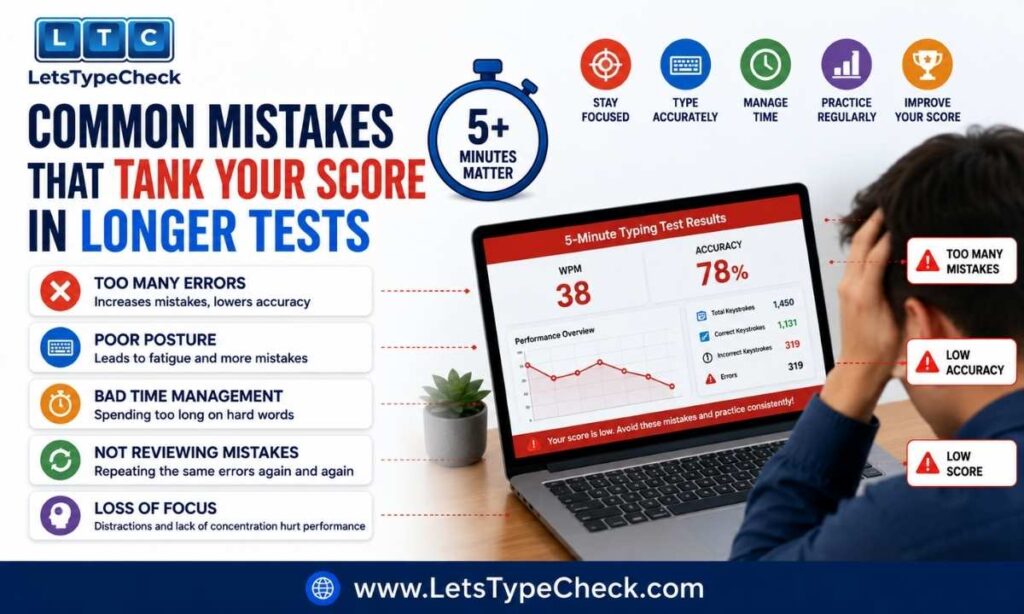
A lot of people who type well for the first ninety seconds still walk away with a disappointing 5-minute score. It’s rarely a skill problem — it’s usually one of these:
- Fatigue-driven slowdown after minute 3 or 4, as hand tension builds and reaction time quietly drops
- Overusing backspace to fix minor errors instead of letting small mistakes go and maintaining rhythm
- Losing your typing rhythm after a single typo and “chasing” the mistake instead of resetting calmly
- Poor posture that was tolerable for a minute but causes real discomfort by minute four or five
5-Minute Test Scores vs. Real-World Typing Speed
It’s common to score lower on a timed test than you’d expect based on how fast you feel when typing normally, and there are a few honest reasons for that. Test anxiety measurably slows most people down. The passage style in a formal test is often less familiar than the casual text, code, or shorthand you type day to day. And there’s no autocorrect or predictive text quietly cleaning up your mistakes behind the scenes, the way there is in a phone or a word processor. None of that means your real-world speed is fake — it just means a clean test score and comfortable daily typing measure slightly different things.
Frequently Asked Questions
Is a 5-minute typing test more accurate than a 1-minute test?
Yes, generally. A longer sample smooths out the effect of any single mistake or lucky streak, giving you a more reliable picture of your true sustained speed.
What WPM do I need to pass a government exam typing test?
It varies by exam and language, but many competitive exams set the bar between 25 and 35 WPM with a capped error rate. Always check the specific exam notification for the exact requirement.
Why does my speed drop toward the end of a 5-minute test?
This is almost always fatigue or lost focus, not a skill limit. Building endurance with longer practice sessions over time closes most of that gap.
Can I retake the test if I make a mistake?
Yes — there’s no limit on attempts. Most people see their best, most representative score after two or three tries in one sitting.
How often should I practice with the 5-minute format?
Two to three times a week is enough to build real endurance without causing fatigue or strain. Daily short accuracy drills can fill the gaps in between.
Is 40 WPM good for a 5-minute test?
It’s solidly average — comfortably above beginner level and enough for most everyday and entry-level office typing needs, though many professional roles ask for more.