
If you’ve ever finished a typing test and wondered whether your score is actually normal for someone your age, you’re asking the right question. A 22-year-old and a 55-year-old comparing themselves against the same flat “average” number is like comparing a sprinter’s time to a marathoner’s — the benchmark only makes sense once you know which race you’re actually running.
Typing speed isn’t fixed. It climbs steadily through childhood and the teenage years, peaks somewhere in the twenties, then eases off gradually — not because fingers stop working, but because daily keyboard habits change. Below is a full age-by-age WPM chart, an explanation of why the numbers move the way they do, and what you can actually do about it, whatever bracket you fall into.
Average Typing Speed by Age: Full WPM Chart
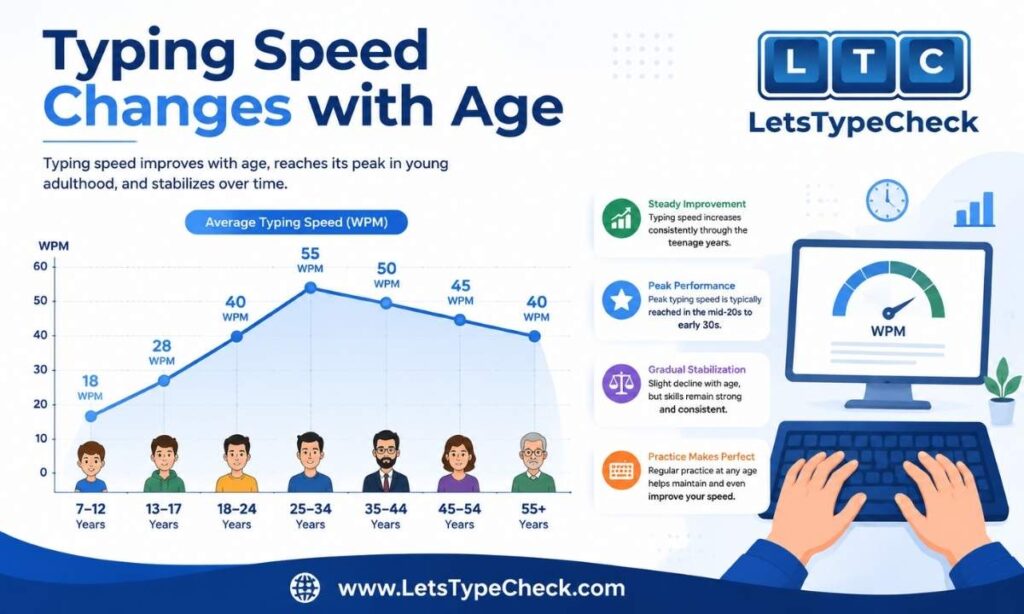
Typing speed tracks two things at once: how developed your fine motor control is, and how many hours a week you actually spend on a keyboard. Both peak in early adulthood, which is why the chart below rises quickly through school age, tops out in the twenties, and only drifts down slowly after that — accuracy and experience usually make up for most of the difference.
| Age Group | Typical WPM Range | What’s Happening |
| 5–9 years | 5–15 WPM | Just learning where the keys are; mostly one or two fingers |
| 10–13 years | 15–30 WPM | School typing exposure begins; still mostly looking at the keyboard |
| 14–17 years | 30–50 WPM | Messaging, gaming, and coursework push speed up quickly |
| 18–25 years | 45–65 WPM | Peak bracket — heaviest daily keyboard use of any age group |
| 26–40 years | 40–60 WPM | Speed holds close to peak for people who type daily at work |
| 41–60 years | 35–55 WPM | Small, gradual dip in reaction time; accuracy often improves |
| 60+ years | 25–45 WPM | Wider range — depends heavily on how much someone still types |
Two things worth noticing in that table. First, the ranges overlap a lot — a disciplined 50-year-old and an average 22-year-old can easily land on the same number. Second, the gap between “peak” and “older adult” is smaller than most people expect: it’s roughly 15–20 WPM, not the dramatic drop-off people assume.
Why Typing Speed Changes with Age
Childhood: Building the Wiring
Young kids aren’t slow because they lack effort — their hands are still growing and the neural pathways that connect “see a letter” to “move the right finger” are still being built. This is also why looking at the keyboard is so common at this stage; the visual search step hasn’t been replaced by muscle memory yet. Speed climbs fast here because every week of practice compounds.
The Teenage Acceleration
Somewhere between 13 and 17, typing speed usually jumps. It isn’t formal instruction driving this — it’s volume. Group chats, assignments typed instead of handwritten, and gaming all add up to daily reps that most adults never had at that age. Teenagers who’ve had even one structured typing class tend to separate from the pack quickly.
The Peak Window: Early-to-Mid Twenties
This is where motor skill and usage line up perfectly. Fine motor control has finished developing, and daily typing volume — university, early-career work, constant messaging — is usually at its highest. It’s less a biological ceiling and more a usage ceiling: nobody types more in a given week than a busy 23-year-old.
Why the Decline After 40 Is Smaller Than People Think
Reaction time and fine motor speed do slow gradually with age — that part is real. But the drop shows up far less in typing than in, say, sprint speed, because typing performance leans heavily on pattern recognition and predictive finger movement, not raw reflex. An experienced typist has effectively pre-loaded thousands of common word patterns, so their fingers are often already moving before their conscious brain has “read” the next word. That kind of experience offsets a meaningful chunk of the natural slowdown.
The practical takeaway: consistency beats age. Someone who types for two hours a day at 50 will comfortably out-type someone who barely touches a keyboard at 20.
Speed vs. Accuracy by Age
WPM alone doesn’t tell the full story — accuracy tends to move in the opposite direction from raw speed as people get older, which is part of why “slower” doesn’t always mean “worse.”
| Age Group | Typical Accuracy | Pattern |
| Under 13 | 80–90% | Speed is inconsistent; accuracy dips further whenever they rush |
| 14–25 | 88–94% | Fastest raw speed, but errors climb noticeably under time pressure |
| 26–55 | 92–97% | Speed levels off; accuracy steadily improves with typing experience |
| 56+ | 93–98% | Often the most accurate group — slower pace, fewer careless errors |
This is why a 45 WPM score from a 50-year-old with 97% accuracy and a 55 WPM score from a 20-year-old at 89% accuracy can represent roughly the same real-world output once you factor in time lost to corrections. Net WPM — speed adjusted for errors — is a fairer comparison across age groups than raw WPM alone.
Average Typing Speed by Age for Government Exam Aspirants
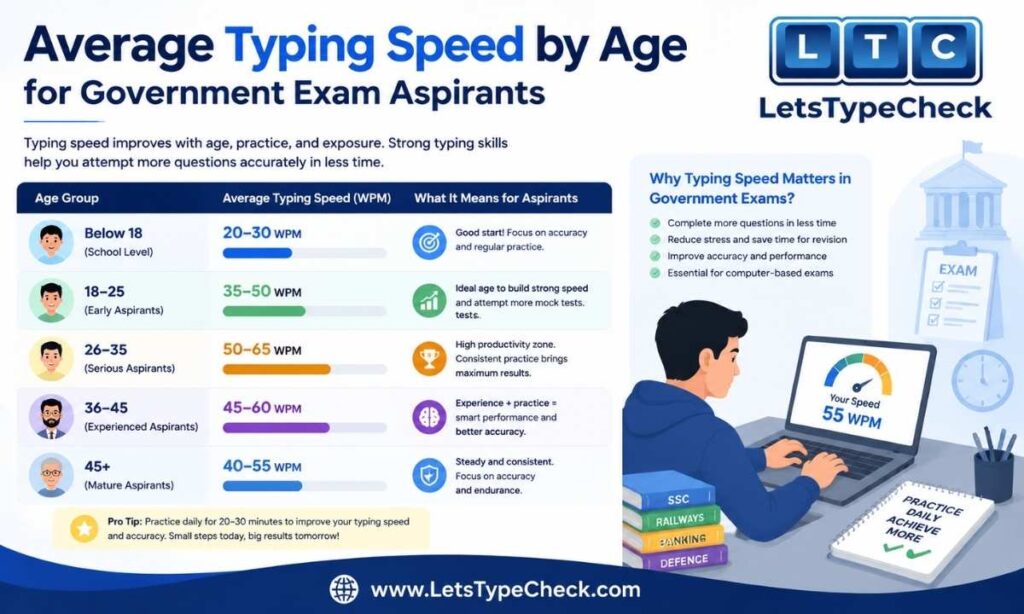
If you’re preparing for SSC, CPCT, RRB, or a similar typing-based government exam in India, the age benchmarks above are a useful reality check but not the actual bar you need to clear — exam requirements are fixed, not age-adjusted.
- Most SSC-level English typing tests require around 30–35 WPM with high accuracy — well within reach of the 18–25 age bracket’s natural range, but it still needs deliberate practice under timed, exam-style conditions.
- Younger aspirants (late teens, early twenties) usually have the raw speed already; the gap is almost always accuracy and stamina over the full test duration, not typing speed itself.
- Older aspirants re-entering exam prep after years away from regular typing often sit slightly below their old average — the fix is short, focused daily sessions rather than long infrequent ones, since typing speed rebuilds faster than most people expect.
- Whatever your age, practicing on the same test duration and format as your target exam matters more than chasing a generic “good WPM” number.
What to Do If You’re Below Average for Your Age
Being under the range for your age bracket isn’t a red flag — it’s just a starting point. What actually helps depends on where you’re starting from.
If You’re a Parent of a Young Typist
Don’t chase speed yet. At this age, accuracy and correct finger placement matter far more than WPM — speed follows naturally once the habit is built. Short 10–15 minute sessions, a few times a week, beat one long weekly session every time.
If You’re a Teen or Student
You likely already have decent raw speed from messaging and gaming — the missing piece is usually structure. A few focused sessions on proper touch typing technique can convert scattered habits into a faster, more reliable score, especially useful heading into typing-based school assessments or entrance requirements.
If You’re a Working Adult
The fastest gains here come from closing the gap between how you type casually and how you type under test conditions. Most adults are faster in real messages than in a timed test simply because familiar phrasing masks slower typing. Regular timed practice on unfamiliar text closes that gap quickly.
If You’re 50+
Don’t compare yourself to a 25-year-old’s number — compare yourself to your own baseline. Consistent short practice sessions rebuild speed faster than expected at this stage, and your natural accuracy advantage already puts you ahead on the metric that matters most in real work: net output, not raw WPM.
For a step-by-step plan that works at any age, see How to Type Faster — 10 Proven Tips.
How Does Your WPM Compare, Regardless of Age?
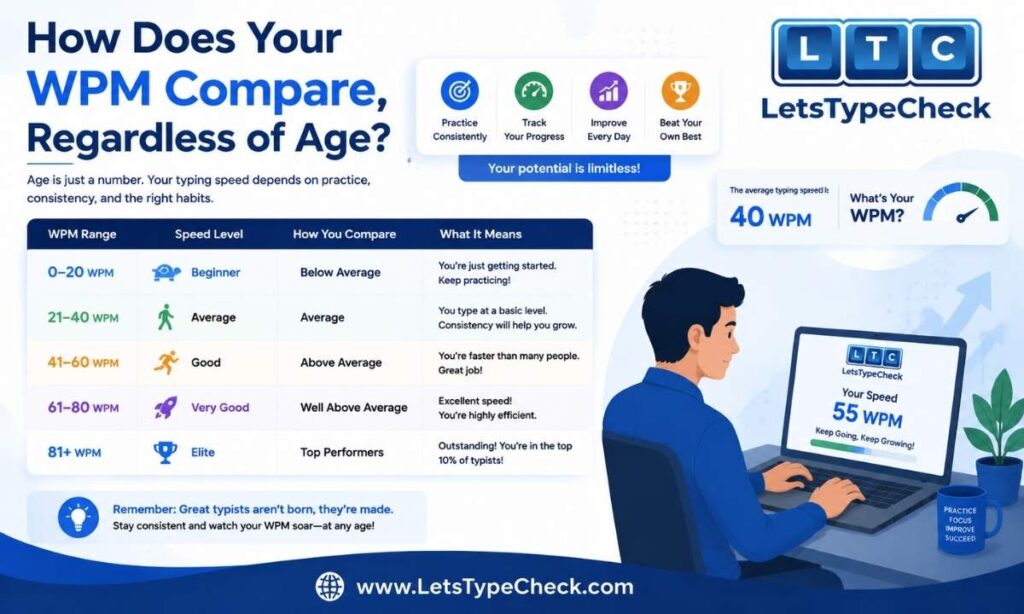
Age explains a lot of the spread in typing speed, but skill tier is a more useful way to think about where you actually stand today — and what the next realistic step looks like.
| Tier | WPM Range | What It Means |
| Just starting out | Under 20 WPM | Still learning key positions; looking at the keyboard is normal |
| Developing | 20–35 WPM | Basic muscle memory is forming; speed is inconsistent |
| Comfortable | 35–50 WPM | Solid for everyday typing — emails, notes, casual writing |
| Strong | 50–70 WPM | Meets most office and exam requirements with room to spare |
| Advanced | 70–90 WPM | Well above typical requirements; noticeable technique advantage |
| Elite | 90+ WPM | Rare without years of deliberate, focused practice |
Not sure which tier you’re in right now? Take a free 1-minute typing test and get your exact WPM and accuracy on the spot.
Frequently Asked Questions
What’s a good typing speed for a 10-year-old?
Somewhere between 15 and 25 WPM is typical at this age, and accuracy matters more than the number itself. Kids who’ve had even a few structured lessons often land toward the higher end of that range.
What’s the average typing speed for a teenager?
Most teenagers fall between 30 and 50 WPM, with speed climbing quickly through the high school years as messaging, gaming, and coursework add up to regular keyboard time.
What’s a normal typing speed for an adult?
Most working adults land somewhere between 35 and 60 WPM, depending heavily on how much daily typing their job or habits actually involve — not on age alone.
Does typing speed really decline after 60?
It dips slightly for most people, typically by 10–20 WPM compared to their twenties, but the decline is far smaller than commonly assumed. Regular typers in their 60s and beyond frequently outperform much younger occasional typers.
Can an older adult type faster than a teenager?
Yes, easily. Daily habit matters more than age at almost every stage of life — someone in their 50s who types for hours a day will typically beat a teenager who only types occasionally.
Is my typing speed good for my age if it’s near the average?
Landing in the middle of your age bracket’s range is a solid, functional speed for everyday use. Whether it’s “good enough” really depends on what you need it for — casual use, office work, or a specific exam requirement each set a different bar.
Why do I type faster in messages than on a typing test?
Familiar phrases and muscle-memorized replies let you type without much conscious thought, while a typing test uses unfamiliar text that removes that shortcut — so test scores usually read a bit lower than how fast typing feels day to day.
How can I find out my exact typing speed right now?
The quickest way is a short timed test rather than guessing. You can check your exact WPM and accuracy with our free 1-minute typing test.
Conclusion
Age gives you a rough starting point, not a ceiling. Speed climbs through childhood, peaks in the twenties when motor skill and daily usage line up, then eases off slowly — and accuracy quietly picks up much of the slack that raw speed loses. The number that matters most isn’t how you compare to a stranger in a different age bracket; it’s whether your current speed serves what you actually need it for, and whether it’s still improving.
Curious where you land? Test your typing speed now, or read our full breakdown of What Is a Good Typing Speed? for benchmarks by job and exam type.