
Meta description: See the fastest typing speeds ever recorded, from 1920s typewriter champions to modern 200+ WPM online records, and what they mean for you.
Search “fastest typing speed ever recorded,” and you will run into a different number depending on where you look: 147 WPM, 212 WPM, 216 WPM, even 305 WPM. None of these figures is wrong. They are simply measuring different things — a one-minute burst on a modern online platform is not the same feat as sustaining a speed for 55 minutes on a manual typewriter in 1923. The confusion is understandable, and most articles on this topic don’t clear it up.
This guide lays out the actual record-holders in chronological order, explains why some of the biggest names (like Barbara Blackburn) are no longer official Guinness records, separates burst records from sustained records so you’re comparing like with like, and breaks down the technique and practice volume behind these speeds — along with what they realistically mean if your own typing speed isn’t anywhere close.
A Timeline of the Fastest Typing Speeds Ever Recorded
Typing speed records span more than a century of typewriters, electric typewriters, and now online competitive platforms. Here is the full lineage in one place:
| Year | Typist | Speed | Device / Platform | Notes |
| 1923 | Albert Tangora | 147 WPM (60-min record); 159 WPM one-minute sprint | Manual typewriter (Underwood Standard, QWERTY) | Still stands as the manual-typewriter record |
| 1946 | Stella Pajunas | 216 WPM (peak, one-minute test) | IBM electric typewriter | Stood for decades as the outer limit of human typing |
| 1976–1986 | Barbara Blackburn | 212 WPM peak / 170 WPM sustained (55 min) | Dvorak keyboard | Guinness “Typing, Fastest” category listing |
| 1986 | Barbara Blackburn | 212 WPM self-claimed, brief burst | Dvorak keyboard | After Guinness had already dropped the category |
| 2010 | Sean Wrona | 163 WPM | Ultimate Typing Championship, standard 574-word text | Called an unofficial world record at the time |
| 2020 | Chak (Ultimate Typing Championship) | 210.4 WPM (best single race) | Online race, Ultimate Typing Championship final | Defeated Sean Wrona in the final |
| Recent | MythicalRocket | 305 WPM (unofficial) | TypeRacer, short burst / single sentence | Not independently verified outside the platform |
A few things stand out from the timeline. First, the jump from mechanical to electric typewriters (Tangora to Pajunas) produced a real, physical speed increase — lighter key resistance genuinely let fingers move faster. Second, the modern online-platform figures (Wrona, Chak, MythicalRocket) reflect a different measurement environment entirely, which is exactly why they shouldn’t be compared to Blackburn’s Guinness-era numbers without context.
Why Guinness Removed the “Fastest Typist” Category
Barbara Blackburn is the name most people associate with “world’s fastest typist,” and for good reason — she appears in the 1976 through 1986 editions of the Guinness Book of World Records, listed as able to reach 170 WPM sustained for 55 minutes on a Dvorak keyboard. What often gets left out is that Guinness pulled typing speed records for electronic and computer keyboards from the 1987 edition onward, citing concerns about the accuracy and verifiability of the results.
- Timing matters: Blackburn’s self-reported peak of 212 WPM, from 1986, came after Guinness had already stopped actively tracking the category — it was never itself Guinness-verified.
- No current official record: there is currently no actively maintained, official Guinness category for “fastest typing speed” on a standard keyboard.
- Why it matters for later records: this is exactly why competitive typing platforms today rely on their own internal leaderboards and verification systems rather than pursuing Guinness recognition.
Not All “Fastest Typing” Records Measure the Same Thing
This is the piece most articles on this topic skip entirely, and it’s the reason the same search query returns wildly different numbers. A typing speed record is only meaningful next to the conditions it was set under:
| Record Type | What It Measures | Example |
| Single-sentence burst | Peak speed over a few seconds on a short, often self-selected string of easy words | MythicalRocket’s 305 WPM on TypeRacer |
| Short timed test (1 minute) | Peak speed sustained across a full one-minute passage | Stella Pajunas’s 216 WPM; Barbara Blackburn’s 212 WPM peak |
| Sustained multi-minute test | Speed held over 30–55+ minutes, the hardest to fake or fluke | Barbara Blackburn’s 170 WPM over 55 minutes; Tangora’s 147 WPM over 60 minutes |
| Standardized competition passage | Identical text for every competitor, judged head-to-head | Ultimate Typing Championship finals (Wrona vs. Bowen, Wrona vs. Chak) |
As a rule, the shorter and more self-selected the text, the higher the peak number — and the less it tells you about real-world, sustained typing ability. A 305 WPM single-sentence burst, and a 170 WPM 55-minute sustained speed are both legitimate records, but they answer different questions.
How the Fastest Typists Actually Do It
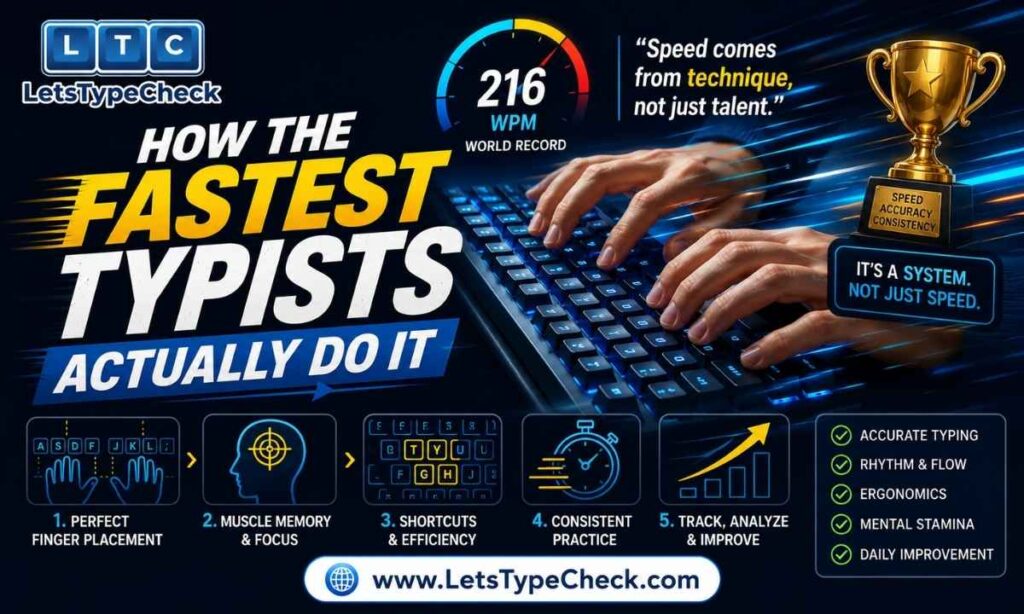
At 200 WPM, the average gap between keystrokes is roughly 60 milliseconds — about the length of a single blink. That’s far faster than a single deliberate finger movement, which raises an obvious question: how is it physically possible?
- Parallel movement, not sequential typing: elite typists don’t type one key at a time in sequence. They pre-program short bursts of keystrokes and execute them in overlapping, cascading motions — the neural command for a keystroke three positions ahead is already being prepared while the current one is still being typed. It’s the same principle behind a pianist playing fast passages without consciously deciding each note.
- Flow state: elite typists reach and maintain flow states — periods of deep focus where the mechanical act of typing runs on autopilot, freeing up mental bandwidth for reading ahead and maintaining rhythm.
- Rhythm over raw speed: champions prioritize even, predictable rhythm over maximum-speed bursts. Consistent pacing is what allows high speed to be sustained for minutes at a time without errors piling up or fatigue setting in.
What It Actually Takes to Get There
None of the above happens by accident. The typists behind these records share a few things in common:
- Years of accumulated practice: many of the fastest competitive typists today report keyboard use starting around age seven or eight, with focused competitive practice beginning in their teens — in line with the broader research on deliberate practice suggesting elite performance in most skills takes somewhere in the range of 10,000 hours of focused effort.
- Accuracy before speed: accuracy is trained first, with speed layered on only once error rates are consistently low — champions typically maintain 99%+ accuracy even at their fastest speeds.
- Equipment and setup: mechanical keyboards with optimal key travel, consistent hand and finger positioning, and a stable, distraction-free environment all play a supporting role — not the deciding factor, but a real one.
- Competitive community involvement: today’s fastest typists have largely emerged from online competitive communities — platforms like TypeRacer (launched 2008) and Monkeytype — where real-time races and leaderboard rankings have pushed practice methods (short-burst drills on specific word lists, targeted practice on weak letter combinations) well beyond what general prose practice used to produce.
Common Myths About Speed Typing
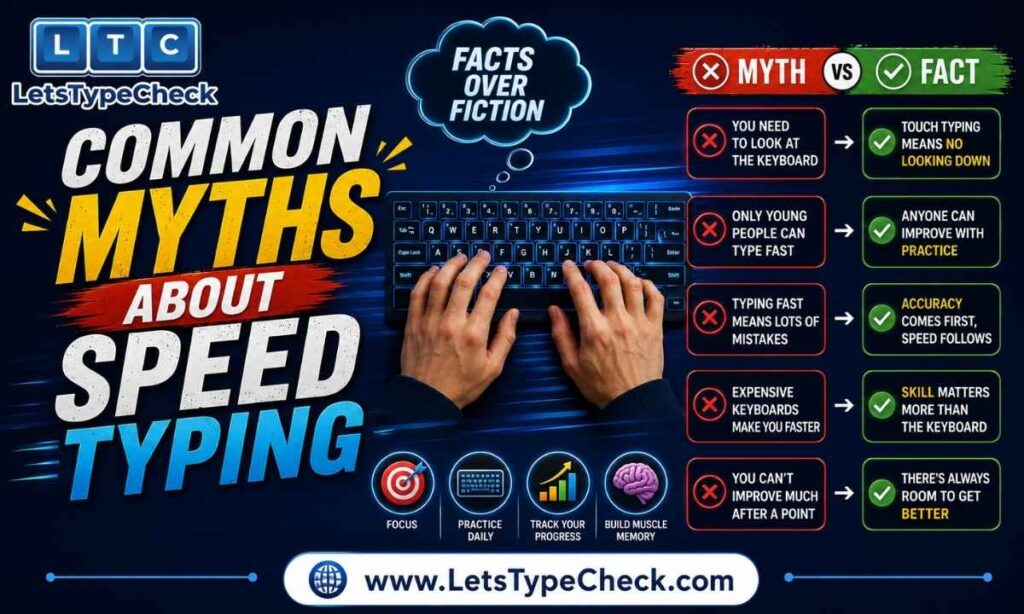
- “You have to be young to be fast.” Age is not a barrier to fast typing — typists in their 40s and 50s continue to break personal bests with consistent practice.
- “Speed comes naturally.” Training and repetition, not natural talent, account for the overwhelming majority of the gap between an average typist and an elite one.
- “Accuracy doesn’t matter once you’re fast.” Record-holders maintain 99%+ accuracy even at their fastest speeds — sloppy fast typing simply doesn’t produce record-caliber results.
- “Equipment doesn’t matter.” A keyboard with poor key travel or high actuation force will cap how fast anyone can reasonably type, regardless of skill.
What These Records Mean If You’re Nowhere Close
It’s worth being honest here: almost nobody needs to type anywhere near 150–300 WPM. These numbers are upper-bound curiosities, not a realistic target. The speeds that actually matter for school, office work, and most competitive exams sit far below the record books:
- 30–40 WPM: this is the realistic goal for someone starting out, and it’s well ahead of the WPM requirement for most Indian government typing exams (SSC, CPCT, and RRB typically require 30–35 WPM).
- 50–70 WPM: this range covers most office and administrative jobs comfortably.
- 80–100 WPM: this is a genuinely fast, professional-level speed — noticeably faster than the vast majority of typists, without needing anywhere near record-level technique.
If you want a clearer sense of where your own speed stands, check out our guide on what counts as a good typing speed, or see how typing speed typically changes across
different age groups. If you’re just getting your numbers straight, our
What Is WPM? guide breaks down exactly how these figures are calculated. And if you want to see your own number, take a
free typing test — or work through our
tips for typing faster if you’re aiming to close the gap.
Frequently Asked Questions
Who currently holds the fastest typing speed record?
There is no single, currently active official record. Barbara Blackburn is the name most commonly cited (212 WPM peak, 170 WPM sustained for 55 minutes), but modern online platforms have recorded higher, less formally verified figures.
Is Barbara Blackburn’s typing record still official?
Not in the sense of an active Guinness listing. Guinness removed the “Typing, Fastest” category for electronic and computer keyboards from the 1987 edition onward, citing accuracy concerns, so her figures remain historically significant but not currently tracked.
What’s the difference between a burst record and a sustained record?
A burst record measures peak speed over a few seconds or one short sentence, which tends to produce much higher numbers. A sustained record measures speed held consistently over several minutes, which is a far harder and more meaningful benchmark of real typing ability.
Can I test my own typing speed against these records?
Yes — you won’t get anywhere near 200+ WPM on your first try, and that’s completely normal. Take a free typing test to see your current baseline, then track your progress from there.
What’s a realistic typing speed to aim for?
For most people, 50–70 WPM comfortably covers office and everyday typing needs, while 80–100 WPM is considered genuinely fast. Government exam requirements in India (SSC, CPCT, RRB) typically sit around 30–35 WPM, far below record-book territory.