
If you’ve ever taken a typing test, you’ve seen your score reported in WPM. But every so often, a job posting, a certification, or a different typing platform reports a number in CPM instead — and suddenly you’re left wondering whether 300 CPM is fast or slow, and why the site didn’t just show you WPM as every other test does.
The short answer: WPM and CPM measure the same thing — how much you type per minute — they just use different units to count it. WPM counts standardised “words.” CPM counts raw characters. Once you know how the two connect, converting between them takes seconds, and you’ll never be confused by a CPM score again.
What WPM and CPM Actually Measure
WPM (Words Per Minute) is the number of standardised words you type in one minute. In typing tests, a “word” isn’t a real dictionary word — it’s any group of 5 characters, including spaces and punctuation. This keeps scores fair regardless of whether you’re typing short words like “a” and “it” or long ones like “responsibility.” For the full breakdown of the formula and how it’s calculated, see our guide to WPM.
CPM (Characters Per Minute) is the raw count of every character you type in one minute — letters, spaces, numbers, and punctuation — with no standardisation applied. It’s a more granular, unprocessed number than WPM.
Both metrics describe the same underlying skill: how fast your fingers move across the keyboard. WPM just repackages the character count into a friendlier, more universal unit.
The Formula That Connects Them
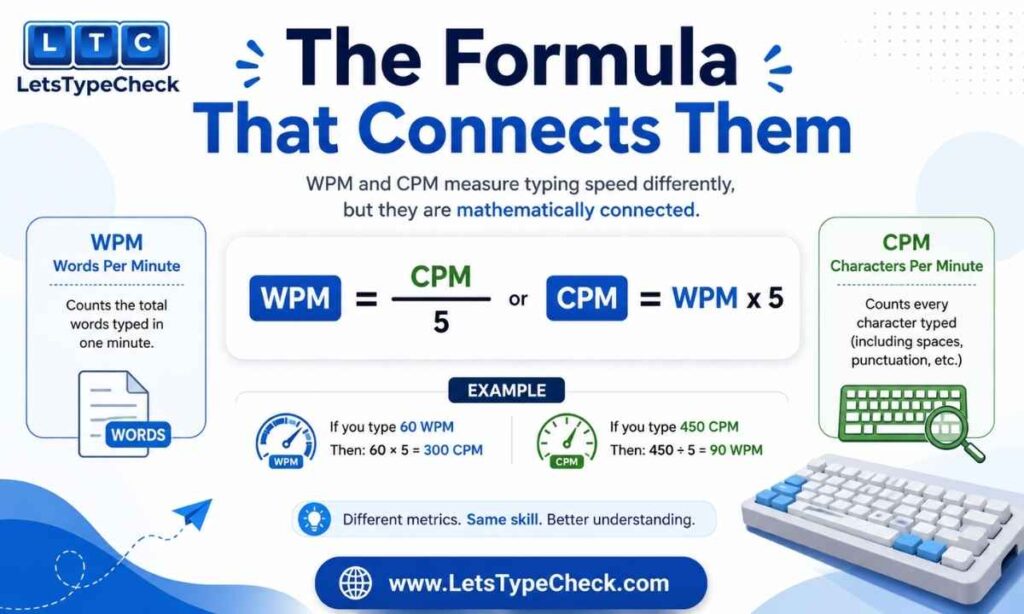
Because a “word” is defined as 5 characters, the conversion between WPM and CPM is simple multiplication or division.
WPM = CPM ÷ 5
CPM = WPM × 5
Worked example: If you type 300 characters in one minute, your CPM is 300. Divide by 5, and your WPM is 60. Flip it around: a typist who scores 60 WPM is producing 300 CPM.
This relationship is fixed and doesn’t change based on test length, language, or platform — as long as both metrics use the same 5-character standard. (A handful of non-English typing systems don’t use this standard, which is covered further down.)
Why Typing Tests Use a 5-Character “Word” in the First Place
Real words vary enormously in length. Typing “I” takes one keystroke. Typing “internationalization” takes 20. If a typing test simply counted real words, someone typing short, common words would score higher than someone typing long, technical ones — even if both people moved their fingers at the same speed.
The 5-character standard removes that unfairness. It treats every “word” as the same length, so two typists working through completely different passages can still be compared on equal footing. This is also why your WPM score is a calculated number, not a literal word count — the software divides your character total by 5 (then applies the time and, in most tests, an error penalty) rather than counting actual dictionary words.
CPM and Other Typing Metrics
WPM and CPM aren’t the only two units typing speed gets measured in. Depending on the country, industry, or platform, you may also encounter these:
| Metric | Full Name | Formula | Common Use |
| WPM | Words Per Minute | CPM ÷ 5 | Universal standard, English-language typing tests |
| CPM | Characters Per Minute | WPM × 5 | Data entry, non-Latin scripts, precise measurement |
| KPH | Keystrokes Per Hour | CPM × 60 | Numeric/10-key data entry, government and banking roles |
| APM | Anschläge Pro Minute | Same as CPM | Germany, Austria, Switzerland |
KPH in particular shows up on job listings for numeric data entry, where speed is measured on the number pad rather than across a full keyboard of letters — it isn’t directly interchangeable with WPM, since typing prose and entering numeric strings use different motor patterns.
When CPM Is the More Honest Number
WPM is the dominant metric in English-speaking countries, but CPM has real advantages in specific situations:
Non-Latin scripts. Languages like Chinese and Japanese are typically measured in CPM (sometimes called CCPM) rather than WPM. Input methods like Pinyin or Romaji require several Latin keystrokes to produce a single character, so forcing a 5-character “word” standard onto the result distorts the comparison. Characters per minute is the more meaningful figure.
German-speaking countries. Germany, Austria, and Switzerland typically report speed as APM (Anschläge pro Minute), which is functionally identical to CPM. A job posting asking for “300 APM” is asking for the same thing as 300 CPM — roughly 60 WPM.
Technical and code typing. For programmers and anyone typing symbol-heavy text (brackets, semicolons, operators), CPM reflects effort more accurately than WPM, since a lot of that “typing” isn’t made up of natural words at all.
Historical origin. CPM-style character counting actually predates the WPM standard. Mechanical typewriters and telegraph operators measured output in raw characters or signals long before the 5-character “word” convention became the norm in the English-speaking world during the typewriter era.
Quick WPM to CPM Conversion Reference
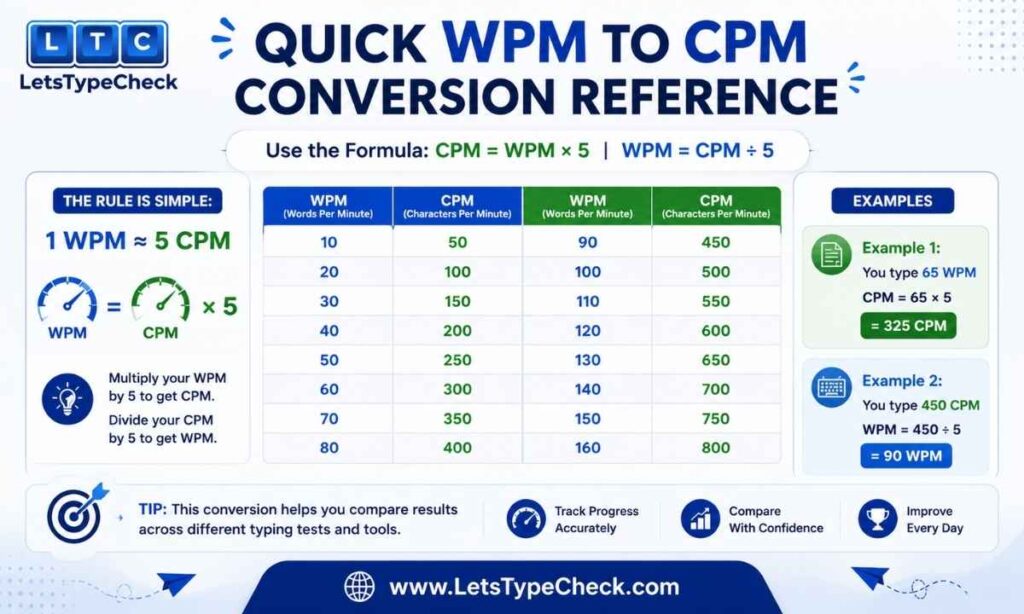
Use this table to convert either direction without doing the math yourself.
| WPM | CPM |
| 20 | 100 |
| 30 | 150 |
| 40 | 200 |
| 50 | 250 |
| 60 | 300 |
| 70 | 350 |
| 80 | 400 |
| 100 | 500 |
| 120 | 600 |
For context on where these numbers sit relative to other typists, see our breakdown of what counts as a good typing speed and
Which Metric Should You Trust for Job Applications?
If you’re applying for a role in the US, UK, Canada, Australia, or most English-speaking markets, WPM is what employers will ask for and what pre-employment tests will report. It’s the de facto global standard for general office, administrative, and customer service typing.
CPM (or APM/KPH) shows up more often in:
- European job markets, particularly German-speaking countries
- Data entry and numeric-input roles, where KPH is common
- Some legacy government and clerical testing systems
If a job posting gives you a number in an unfamiliar unit, don’t guess — run it through the formula above. A requirement of “250 CPM” is the same bar as 50 WPM, and knowing that instantly tells you whether you’re ready for the role or need more practice first. Our guide on how to type faster can help you close that gap.
Test Yourself and Compare

The only way to know your real numbers — in either unit — is to take a timed test and do the math once so you’re never confused again. Try our typing speed test to get your live WPM, or run a 30-second burst test and a longer 2-minute typing test to see how your speed holds up over different durations — then convert your score to CPM using the table above.
The Bottom Line
WPM and CPM aren’t competing metrics — they’re the same speed, described two different ways. WPM standardizes your typing into 5-character “words,” so scores stay comparable across different texts and typists, while CPM gives you the raw, unrounded character count behind that number. Once you know the formula (WPM = CPM ÷ 5), you can convert between the two instantly, whether you’re reading a US job posting in WPM or a German one in APM.
For most everyday purposes — job applications, school benchmarks, casual practice — WPM is the number worth tracking. But if you’re typing in a non-Latin script, working in a European market, or just curious what your raw character speed looks like, CPM tells the same story from a different angle. Either way, the fastest way to find out where you stand is to take a timed test and check both.
Frequently Asked Questions
Is CPM just WPM multiplied by 5?
Yes, in typing tests that use the standard 5-character “word.” CPM = WPM × 5, and WPM = CPM ÷ 5. This holds regardless of test length, as long as both scores come from the same standard.
Why do some typing tests show CPM instead of WPM?
Some platforms — especially those built for non-English languages, European markets, or technical/code typing — report CPM because it’s a more precise, unprocessed measure of character-level speed. WPM is a repackaged, standardized version of the same underlying number.
Is a higher CPM always better than a higher WPM?
Neither is “better” — they’re the same measurement in different units. A typist at 60 WPM and a typist at 300 CPM are typing at identical speed. What matters is comparing scores using the same unit, or converting first.
Does CPM include spaces and punctuation?
Yes. CPM counts every character you type, including spaces, punctuation, and numbers — the same characters that get grouped into 5-character “words” when calculating WPM.
Which countries use CPM instead of WPM?
CPM (or the equivalent APM) is more common in German-speaking countries like Germany, Austria, and Switzerland, as well as in some non-English typing systems, including Chinese and Japanese, where character-based input doesn’t map cleanly onto the WPM standard.
Is WPM = CPM ÷ 5 the same in every language?
No. The 5-character-per-word standard was built around English. Languages with different average word lengths, or entirely different input systems (like Pinyin or Kana), often use their own metric — usually CPM — rather than forcing the English WPM formula onto a different writing system.