If you’ve searched for a typing test certificate, you’re probably trying to answer one simple question: can I get a document that proves my typing speed? The honest answer is yes — but not every “typing certificate” you’ll find online means the same thing, and not every employer or exam board treats them the same way. Some are instant, free badges from typing-practice websites. Others are paid, formal credentials from typing institutes. And some “typing tests” people confuse with certificates are actually official government skill tests tied to a specific job recruitment cycle, not a certificate at all.
This guide breaks down what a typing test certificate actually is, the different types you’ll come across, realistic WPM benchmarks for each certificate tier, whether employers and government exams accept them, how to spot a legitimate one, and the exact steps to get yours.
What Is a Typing Test Certificate?
A typing test certificate is a document — usually a downloadable PDF or on-screen card — that states your measured typing speed (WPM), your accuracy percentage, and the date you took the test. It’s issued automatically after you complete a timed typing test on a platform that offers certification.
Broadly, typing certificates fall into two categories:
- Free online platform certificates — generated instantly after a self-administered test on a typing-practice website. No cost, no human review, no formal accreditation body behind them.
- Institutional or paid certifications — issued by typing institutes, computer training centers, or recognized skill boards, often after a proctored or fee-based exam, and treated as a more formal credential. In India specifically, this includes certificates from state-registered or Directorate of Technical Education-approved typing institutes, which some older government job postings still reference separately from the exam’s own skill test.
Neither of these is the same thing as an official government typing skill-test scorecard (covered below) — a distinction most people searching this term aren’t aware of.
Types of Typing Certificates
This is the part most guides skip straight past. Here’s how the three categories actually differ:
| Type | Cost | Issued By | Verifiability | Typically Accepted By |
| Free online certificate | Free | Typing-practice websites | Varies — some have a unique ID or QR code, many don’t | Personal proof, informal use, LinkedIn |
| Institutional / paid certification | Often paid | Typing institutes, training centers | Usually higher — formal records kept | Some employers, resume credentials |
| Government exam scorecard | Free (part of exam) | Exam conducting body (SSC, RRB, state boards, etc.) | Official, tied to your exam roll number | That specific recruitment process only |
If you’re prepping for a government job, the free typing certificate you download from a practice site will not substitute for the official skill test — more on that in the section below.
Typing Certificate Levels: What WPM Do You Need?
Most free certificate platforms structure their certificates as tiers, gated by a minimum WPM and accuracy combination. The exact names vary by platform, but the general bands look like this:
| Tier | Typical WPM Range | Typical Accuracy Required |
| Beginner | 20–30 WPM | 85%+ |
| Intermediate | 35–45 WPM | 90%+ |
| Proficient | 50–65 WPM | 95%+ |
| Advanced | 70–90 WPM | 97%+ |
| Expert | 95+ WPM | 98%+ |
Not sure where you currently stand? Check the full breakdown of what counts as a good score for your age and job in our What Is a Good Typing Speed? guide, or see how your speed compares to others your age in Average Typing Speed by Age.
Do Employers Actually Accept Free Online Typing Certificates?
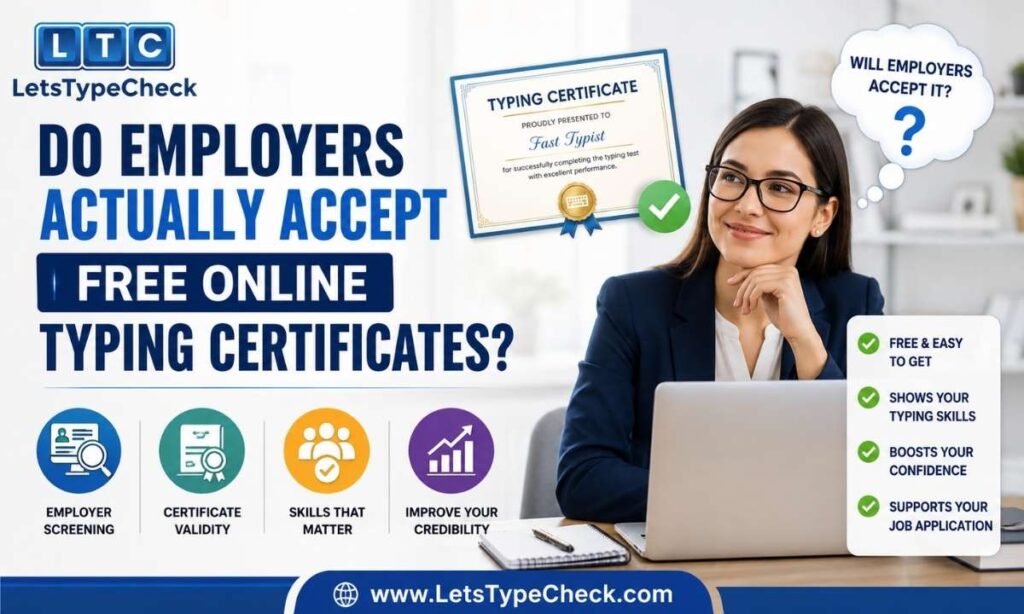
This is the question most people actually care about, and the honest answer is: it depends on the role and the employer.
- For most general office jobs, a free certificate is treated as a nice-to-have signal — it shows you’ve measured your own speed, but employers rarely verify or require it.
- For dedicated typing-heavy roles (data entry, transcription), employers overwhelmingly run their own timed assessment during the hiring process rather than relying on a certificate you bring with you.
- A free certificate can still be worth listing on a resume or LinkedIn profile as supporting evidence — just don’t expect it to replace the employer’s own test.
For a full breakdown of exactly what WPM different professions expect and which testing platforms employers actually use, see our complete guide: Typing Test for Jobs: WPM Requirements by Profession.
Do You Need a Certificate for Government Exams?
This is the single biggest point of confusion around this keyword. If you’re preparing for SSC, RRB, CPCT, or a similar government recruitment exam, the typing portion is an official skill test conducted by the exam body itself — not something you complete in advance and submit as proof.
- A certificate from a third-party typing website does not count toward, replace, or exempt you from the official skill test.
- These exams have their own WPM thresholds, error-tolerance rules, and exam-day software — practicing on a free typing site only helps you prepare, it isn’t accepted as your qualifying score.
- Always confirm the exact requirements from your official exam notification rather than any third-party site, including this one.
If you’re preparing for a specific government exam, see our dedicated guides to typical formats and scoring rules, and check our Gross WPM vs Net WPM explainer to understand how exam scoring actually works.
What Makes a Typing Certificate Legitimate?
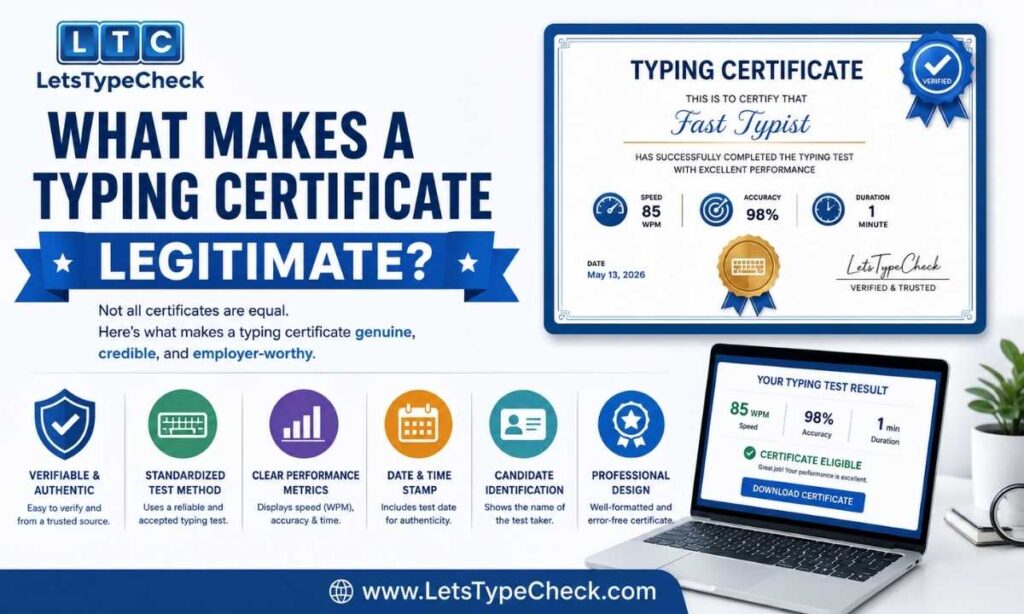
Not all free certificates are created equal. A few things separate a credible one from a throwaway graphic:
- Verifiable ID or QR code — a certificate with a unique reference number or scannable code that a third party can check is more credible than a plain, unverifiable PDF.
- No hidden paywall — if a site advertises a “free” certificate but charges to actually download it, that’s worth knowing upfront.
- Transparent methodology — a legitimate certificate states the test duration and how WPM was calculated (see our What Is WPM? guide if you want the exact formula).
- Realistic claims — be skeptical of any certificate claiming to be “recognized by all employers” or similarly absolute language. No free online certificate carries that kind of universal weight.
How to Get a Typing Certificate: Step-by-Step
If you’ve decided a certificate is worth getting, here’s the practical path:
1. Know your real WPM and accuracy first.
Before chasing a certificate, take a reliable timed test to see where you actually stand. Try our own free typing test to check your current WPM and accuracy — it doesn’t issue a certificate yet, but it gives you an honest baseline before you pursue one elsewhere.
2. Choose a legitimate certificate provider.
Use the legitimacy checklist above — favor platforms with verifiable IDs and transparent scoring over ones making vague claims.
3. Meet the WPM and accuracy threshold for your target tier.
If you’re short of your goal, structured practice closes the gap faster than random typing. Our How to Type Faster and How to Reach 60 WPM guides lay out realistic practice plans.
4. Download, verify, and use it appropriately.
Add it to your resume or LinkedIn as supporting evidence, keep a copy for your records, and — if the platform supports it — save the verification ID separately in case you need to share it later.
Alternatives to a Formal Certificate
A certificate isn’t the only way to show proof of your typing speed. If you don’t need (or can’t get) a formal one, these work just as well in most informal contexts:
- A screenshot of your test results, including WPM, accuracy, and the date
- A documented practice history or streak showing consistent improvement over time
- Simply stating your WPM on a resume with a link to the test you used, so it’s easy to verify
Check Your Real Typing Speed First
Whatever route you take, start with an accurate number. Our test tracks Time Left, WPM, Accuracy, and Mistakes in real time so you know exactly where you stand before pursuing a certificate anywhere else. Take the typing speed test, see how your score compares by age and profession in Average Typing Speed by Age, and check the benchmarks in What Is a Good Typing Speed?.
Frequently Asked Questions
Is a free typing certificate worth putting on my resume?
It can be useful supporting evidence, especially for entry-level or general office roles. Just don’t rely on it as a substitute for an employer’s own assessment — most typing-heavy roles will test you directly regardless of any certificate you bring.
How long does a typing certificate stay valid, and does it expire?
Free online certificates generally don’t carry a formal expiration date — some platforms even list “lifetime validity” — but that mainly means the document itself doesn’t expire, not that your typing speed is guaranteed to stay the same over time. Government exam scorecards work differently: they’re usually valid only for the specific recruitment cycle they were issued for, not indefinitely.
Can I get a typing certificate without paying?
Yes. Several typing-practice platforms issue free certificates instantly after you complete a qualifying test — no payment required for the certificate itself, though some sites charge for premium features.
Is a typing certificate required to apply for SSC, RRB, or other government exams?
No. Applying for these exams doesn’t require you to submit a pre-earned typing certificate from any website. The typing/skill test is conducted by the exam body itself as part of the recruitment process, and that official result is what counts — not a certificate from a third-party platform. Practicing on a free typing site beforehand can still help you prepare, it just isn’t a substitute for the exam’s own test.
Is a typing certificate the same as a government typing skill-test scorecard?
No. A typing certificate from a practice website is a self-administered, informal proof of speed. A government skill-test scorecard (for SSC, RRB, CPCT, etc.) is an official result from a proctored exam tied to a specific job application — the two are not interchangeable.
What WPM do I need for a typing certificate to look good to employers?
For general office roles, 40+ WPM is typically viewed favorably. For dedicated data entry or transcription roles, aim closer to 50–70+ WPM. See our full Typing Test for Jobs guide for role-by-role requirements.
Can I retake a typing test if I don’t pass the certificate threshold?
Yes — on virtually every free platform you can retake the test as many times as you like at no extra cost until you hit your target WPM and accuracy.
The Bottom Line
A typing test certificate can be a useful, free way to document your speed — but it’s not a single, standardized credential, and it’s not a substitute for an official government skill test or an employer’s own assessment. Know your real WPM first, understand which type of certificate (if any) actually fits your goal, and choose a provider with transparent, verifiable scoring rather than the flashiest badge. Start by checking your real number with our free typing test — everything else follows from an honest baseline.